Last month, at the NAACP Labor Luncheon in Chicago, I told a room full of labor leaders that there is an opportunity sitting in front of organized labor that I don’t think we have fully recognized yet. This month, we start training to go after the money being made from our data.
Not only because workers deserve their share of the value they create, but because financial grievances over data could create new revenue for unions, new income for workers and an entirely new constituency for organized labor.
In Chicago, I made an example out of the new fight between the New York State Nurses Association (NYSNA) and Montefiore. Are you familiar with it!?
It may be the perfect example.
NYSNA Is Fighting Over the Jobs. I Want to Follow the Data.
NYSNA says Montefiore eliminated 12 utilization-review nursing positions after introducing AI-powered technology associated with Datavant.
The union is fighting back.
It should.
But if I were advising NYSNA’s lawyers, I would want the grievance to open another door:
Discovery.
I want to know exactly what information makes that technology work.
What data trained it?
What data validates it?
What data improves it?
What information does Montefiore send to Datavant?
What information does Datavant send back?
What happens when a nurse corrects the system?
Are those corrections retained?
Are they used to improve the product?
What human decisions became labels?
What outcomes became validation?
What workflows were captured?
What derivative data was created?
And who contributed all of it?
That last question matters.
Because if Montefiore and Datavant say:
“We didn’t use NYSNA nurses’ data.”
My response isn’t:
Okay.
My response is:
Whose data did you use?
That’s where the financial grievance begins.
Data Doesn’t Come From Nowhere
Think about what a utilization-review nurse actually does.
The nurse doesn’t simply move paperwork.
The nurse reviews a patient’s chart.
Diagnoses.
Procedures.
Medications.
Physician documentation.
Admission information.
Treatment history.
Discharge planning.
Insurance requirements.
Medical-necessity criteria.
Coverage decisions.
Denials.
Appeals.
Then the nurse applies something much harder to quantify:
judgment.
Is the documentation sufficient?
What is missing?
Does this treatment satisfy medical necessity?
Why was this claim denied?
What additional information will the insurer require?
Should the denial be challenged?
What evidence might reverse it?
When the nurse answers those questions, she creates something that did not exist in the medical record alone.
She creates new information.
And if she does that thousands of times over the course of a career, she creates an enormous informational record of human expertise.
Now multiply that by thousands of nurses.
Then physicians.
Coders.
Claims professionals.
Administrative workers.
Patients.
Hospitals.
Insurers.
Contractors.
And everyone else participating in the healthcare system.
That’s an informational supply chain.
And AI sits at the end of it.
Follow the Informational Supply Chain
We know how to trace physical supply chains.
If a manufacturer builds a car, we can identify who supplied the steel, glass, rubber, semiconductors and batteries.
We can identify who assembled it.
We can calculate costs.
We can assign ownership.
We can determine who gets paid.
But when the productive asset is information, something strange happens.
Everyone upstream disappears.
We call the resulting asset “data.”
Then we call it “AI.”
And suddenly nobody remembers where it came from.
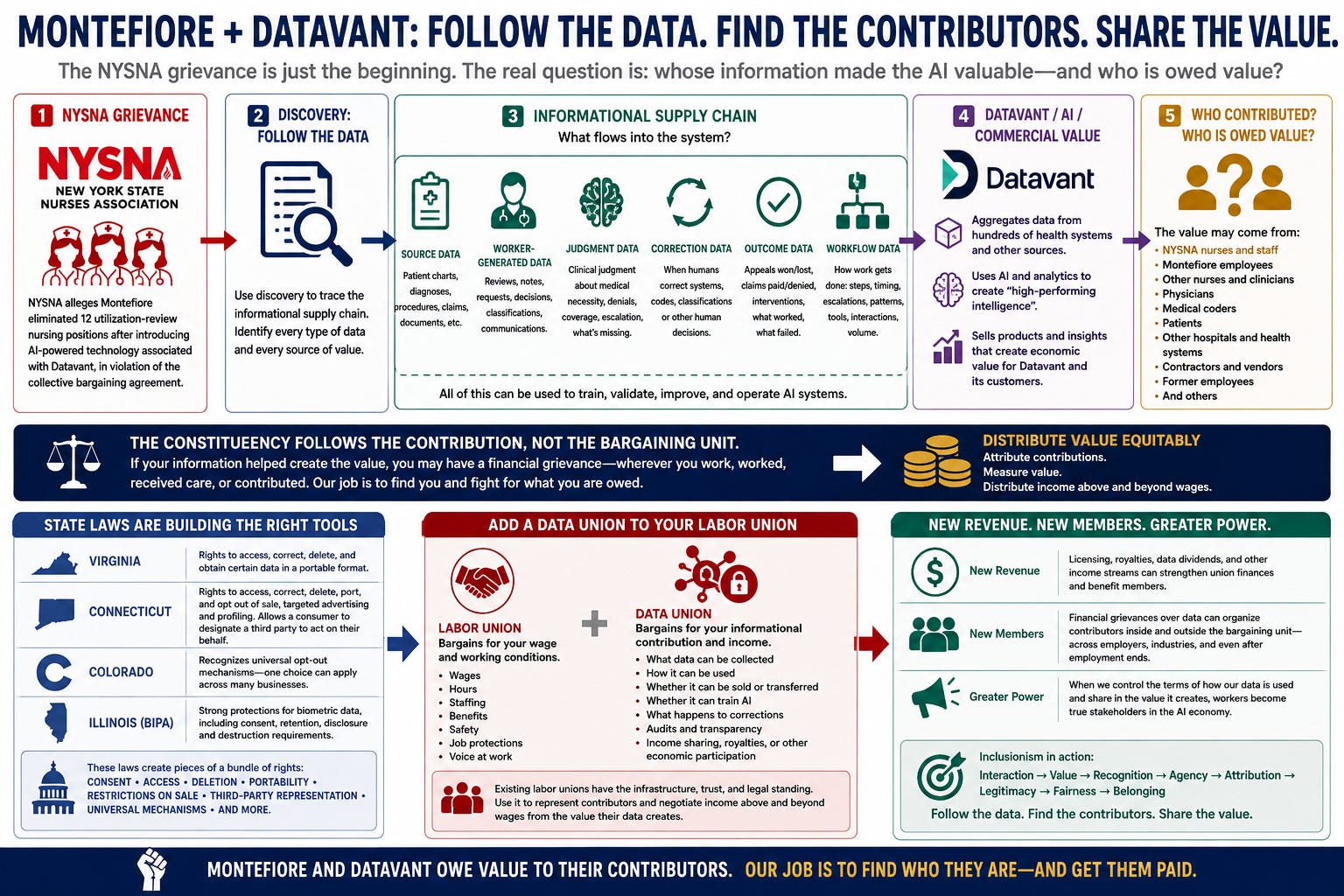
I want discovery to work backward.
Start with the AI system and trace the informational supply chain.
Source data
What clinical records, claims, documents, communications and other information entered the system?
Worker-generated data
What reviews, notes, classifications, documentation requests, decisions and other outputs were created through work?
Judgment data
What human decisions established what was correct, incorrect, relevant, irrelevant, medically necessary or worthy of escalation?
Correction data
When a human disagreed with a system, changed a classification or corrected an error, what happened to that correction?
Outcome data
Which decisions worked?
Which appeals succeeded?
Which claims were paid?
Which classifications were accepted?
Which interventions produced the desired result?
Workflow data
What sequence of human actions produced those outcomes?
What was reviewed first?
What was escalated?
How long did it take?
What did an experienced worker do differently from an inexperienced one?
Derivative data
What scores, predictions, patterns, profiles, models and other informational assets were subsequently created from those contributions?
And finally:
Provenance
Who contributed what?
That is the question.
Suppose Datavant Says It Was Somebody Else’s Data
Good.
Then identify them.
If the system wasn’t developed from Montefiore nurses’ contributions, perhaps it was developed from nurses at another hospital.
Find them.
Maybe physicians contributed.
Find them.
Maybe coders contributed.
Find them.
Maybe utilization-review workers at insurance companies contributed.
Find them.
Maybe contractors contributed.
Find them.
Maybe former employees contributed.
Find them.
Maybe patients contributed information that became economically valuable.
Find them.
The point of discovery should not be to prove that NYSNA members are the only people entitled to value.
The point should be to discover everyone who contributed to the value.
That changes what a labor grievance can become.
The constituency is no longer determined solely by who is currently inside the bargaining unit.
The constituency can follow the contribution.
And that presents organized labor with an enormous opportunity.
A Financial Grievance Can Become an Organizing Strategy
There are millions of union members in America.
There are millions more workers represented by unions.
And there are millions more whose wages, safety, working conditions and economic lives are influenced by what organized labor does.
Now imagine another constituency:
people whose informational contributions have economic value.
Some are union members.
Some aren’t.
Some used to be.
Some work for another employer.
Some may be contractors.
Some may have retired.
Some may not even know that information they helped create became part of a valuable commercial asset.
What happens when a union finds them?
Imagine the organizing conversation:
“We discovered that information you contributed is being used to create economic value. We’re organizing the contributors to determine what they are owed.”
That’s a very different membership proposition.
We normally organize people around what they can earn tomorrow through better wages.
What if we could also organize people around value they already helped create?
That’s why I told labor leaders in Chicago that financial grievances over data could grow both union revenue and union membership.
There is money somewhere in this informational economy.
Follow it.
Your Union Bargains for Your Wage
This distinction is important.
A union bargains for your wage.
That wage compensates you for performing labor.
But what happens when the information produced through that labor continues generating economic value after the labor is finished?
A nurse works the shift once.
The information produced through that work can potentially be stored indefinitely.
Copied.
Aggregated.
Transferred.
Analyzed.
Licensed.
Used to optimize a process.
Used to evaluate other workers.
Used to train or improve an algorithm.
Used to build software.
Used to automate future work.
The labor occurred once.
The informational asset can continue producing value.
So why should the worker’s economic participation necessarily end when the wage is paid?
Capital doesn’t work that way.
An investor contributes capital and expects a return.
Intellectual property can produce royalties.
Property can produce rent.
Equity can produce dividends.
Information can produce continuing economic value too.
So I don’t want organized labor thinking only about wages.
I want organized labor thinking about income above and beyond wages.
If worker-generated information becomes a productive asset, workers should have mechanisms for participating in the value that asset generates.
Royalties.
Licensing income.
Revenue participation.
Data dividends.
Pension contributions.
Collective benefits.
Worker equity.
Maybe mechanisms we haven’t invented yet.
The form can evolve.
The principle comes first:
Contributors should participate in the value of what they contribute.
The Law Is Starting to Give Us Tools
Here’s where this becomes more than an economic theory.
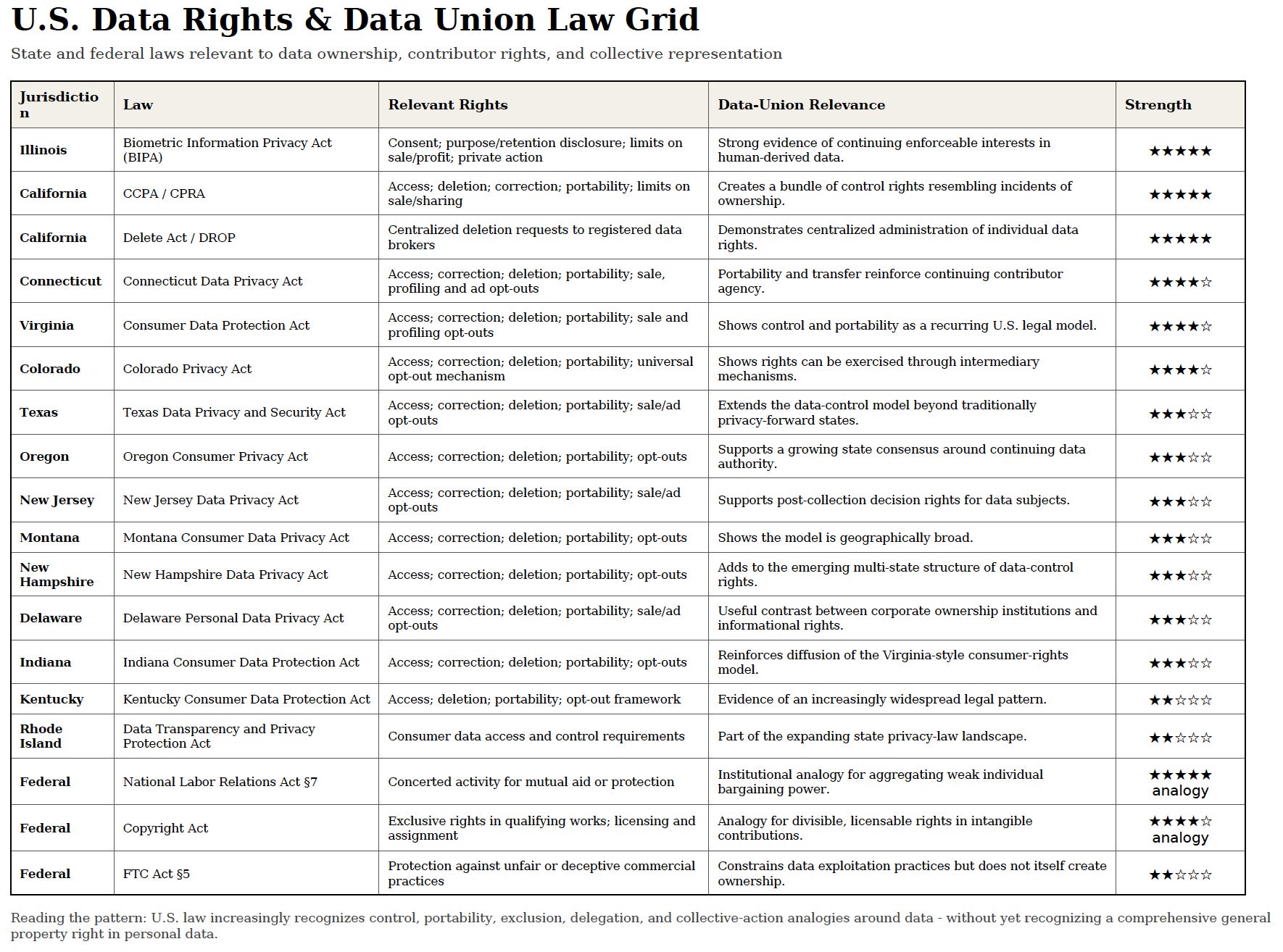
States have spent the last several years quietly creating pieces of a legal infrastructure around data.
Not full ownership.
Not yet.
But pieces.
Illinois has its Biometric Information Privacy Act.
It gives people significant statutory rights concerning the collection and use of biometric identifiers and biometric information.
California gives consumers rights involving access, deletion, correction, portability and restrictions concerning the sale or sharing of personal information.
California’s Delete Act takes another important step: it creates centralized infrastructure through which consumers can exercise deletion rights against registered data brokers.
Virginia provides rights of access, correction, deletion and portability.
Connecticut provides similar rights and permits third-party exercise of certain data rights.
Colorado recognizes universal opt-out mechanisms.
Look at what is emerging across these laws:
Consent.
Access.
Deletion.
Portability.
Restrictions on sale.
Delegation.
Third-party representation.
Centralized administration.
None of those laws, standing alone, creates the economic system I’m describing.
But together they tell us something important.
American law is increasingly rejecting the idea that once a company possesses information, the person from whom that information came has no continuing rights concerning it.
That’s the opening.
Privacy Was Only the First Question
Privacy law asks:
What are you allowed to do with my information?
That’s an important question.
But it’s not the only question.
Agency asks:
Who decides what happens to my contribution?
Attribution asks:
Who contributed to the creation of this informational asset?
And economics asks:
If my contribution helped create something valuable, what portion of that value should come back to me?
That last question is the one organized labor should start asking.
Because labor already has something most individual consumers don’t have.
Collective power.
Add a Data Union to Your Labor Union
One way to exercise that power is through a Data Union.
I am proposing that New York recognize Data Unions and establish contributor rights that people can exercise individually or collectively.
An existing labor union should be able to establish, sponsor or affiliate with one.
The Labor Union bargains for the wage.
The Data Union can bargain over the informational contribution.
That means negotiating questions such as:
What worker-generated data may be collected?
What can it be used for?
Can it be transferred?
Can it be sold?
Can it train AI?
Can it improve a commercial product?
What happens to worker corrections?
Can the union audit its use?
Can contributors obtain their data?
Can contributors delegate their rights collectively?
And where the data generates measurable economic value:
What are the contributors owed?
But I want to be clear about something.
The Data Union is not the philosophy.
It is one institutional tool.
The larger principle is more important.
Follow Contribution, Not Membership
The purpose isn’t to discover that NYSNA nurses’ data created the technology and then divide the money only among NYSNA members.
If that’s where the evidence leads, fine.
But if discovery leads somewhere else, follow it.
If the contribution came from nurses in Ohio, follow it.
If it came from physicians in California, follow it.
If it came from coders in Texas, follow it.
If patients supplied an economically significant informational contribution, follow it.
If the system improves because workers at dozens of hospitals continually correct its mistakes, follow those corrections.
If thousands of people contributed different pieces, determine those pieces.
Then determine their value.
That is the larger principle.
Participation should lead to recognition.
Contribution should lead to attribution.
Attribution should create agency.
And when contribution produces economic value, that value should be distributed equitably among the people and institutions that actually helped create it.
Not equally.
Equitably.
Datavant may have contributed valuable technology.
Recognize it.
Montefiore may have contributed infrastructure and information.
Recognize it.
Investors contributed capital.
Recognize it.
Engineers contributed technical labor.
Recognize it.
Nurses contributed clinical judgment.
Recognize it.
Patients contributed information.
Recognize it.
Coders contributed classifications.
Recognize it.
The question isn’t which one of these participants gets all the value.
The question is:
Why does our current system pretend some of them contributed nothing?
New York Should Create the Missing Rights
New York has an opportunity to lead here.
I am proposing two complementary policies.
The New York Data Contributors’ Rights Act would establish legally cognizable economic rights around qualifying informational contributions.
The New York Data Union Recognition Act would create a mechanism through which contributors can aggregate and exercise qualifying rights collectively.
The first establishes the contributor’s economic interest.
The second creates one institution capable of exercising that interest at scale.
And organized labor is particularly well positioned to do this.
Unions already have members.
Governance.
Lawyers.
Researchers.
Negotiators.
Political operations.
Relationships with employers.
Benefit structures.
Institutional trust.
And more than a century of experience turning individually weak economic actors into a collective force.
We don’t need to recreate that infrastructure.
We need to expand what it is capable of representing.
NYSNA Should Follow the Data
So I come back to those twelve nurses at Montefiore.
Absolutely fight for their jobs.
Absolutely enforce the collective bargaining agreement.
Absolutely challenge the use of AI when it violates negotiated protections.
But don’t stop there.
Use discovery.
Follow the data.
Find the source.
Find the workers.
Find the patients.
Find the judgments.
Find the corrections.
Find the labels.
Find the outcomes.
Find the derivative information.
Find the commercial uses.
Find the money.
And then find the contributors.
Maybe the trail leads directly back to NYSNA members.
Maybe it leads to thousands of people we’ve never met.
Either outcome matters.
Because this is bigger than one grievance.
It is bigger than one union.
And ultimately, it is bigger than Data Unions.
We are building an economy in which information is becoming one of the most valuable factors of production in the world.
That information did not create itself.
People participated.
People contributed.
It’s time our institutions learned how to recognize them.
Your union already bargains for your wage.
Now follow the data and find the income.