
Yesterday The New York Times wrote about How A.I. Helped One Man (and His Brother) Build a $1.8 Billion Company — Let me help you calculate what his company owes us in a Data Dividend.
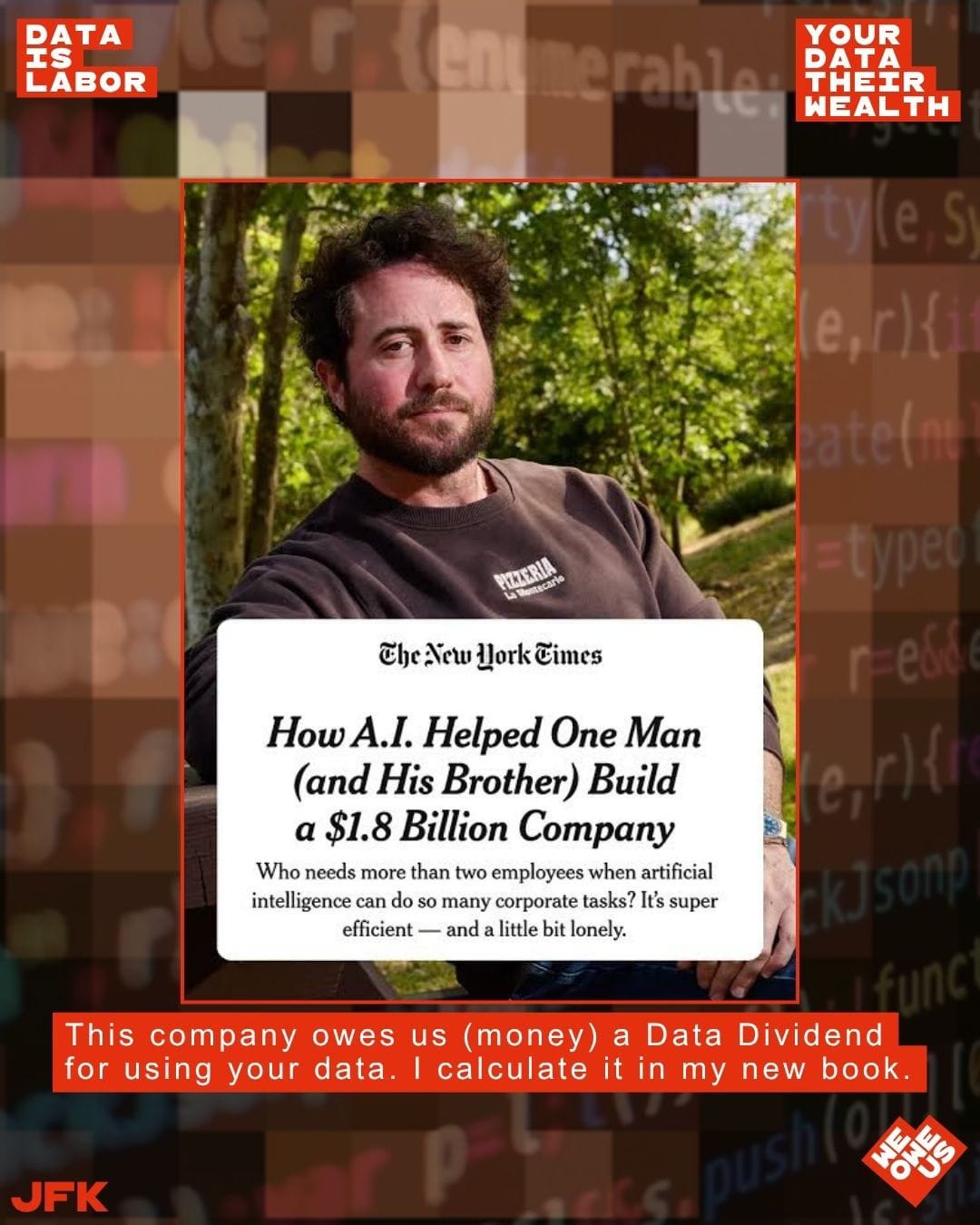
There is a new fairy tale moving through the business press.
A man with a laptop.
A handful of A.I. tools.
A tiny payroll.
And suddenly, hundreds of millions in revenue.
The story is supposed to make us gasp at efficiency. It is supposed to make us bow before the machine. It is supposed to make us believe that labor is becoming optional, that scale no longer needs people, and that the old rules of production have been shattered for good.
Not so fast.
What has actually happened is something older than Silicon Valley likes to admit. A man has found a new way to stand on top of other people’s inputs without paying their full price.
That is not magic. That is not invention from nothing. That is extraction with better software.
The recent New York Times profile of Medvi, the telehealth company built by Matthew Gallagher with just a brother, a few contractors, and a stack of A.I. tools, is being treated like proof that the age of the one-person billion-dollar company has arrived. The numbers are designed to dazzle: $401 million in 2025 sales, roughly $65 million in net profit, and a 2026 sales pace reportedly headed toward $1.8 billion.
But the real story is not that one entrepreneur created all of that value alone.
The real story is that he used artificial intelligence to compress an enormous amount of human contribution into almost no payroll.
That is where my Data Cap Table comes in.
For years, I have argued that modern economics has been misstating production itself. We still pretend that output is mostly a function of capital and labor, as if the digital economy did not exist. As if personal data, behavioral data, preference data, language data, image data, health data, and all the rest were just ambient noise floating around the marketplace for free. As if information were not a factor of production in its own right.
But in the age of A.I., that fiction gets harder to maintain by the day.
The better mathematical way to describe production now is simple:
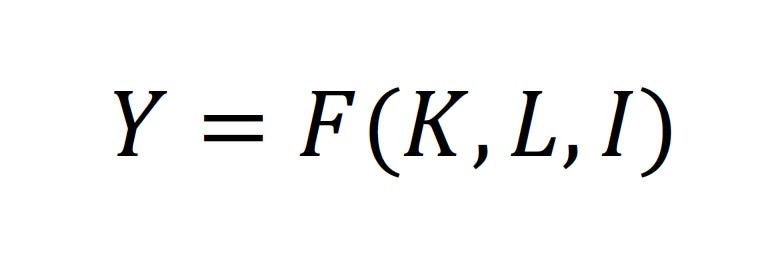
Capital. Labor. Information.
And in this new class of company, information is doing far more work than the books admit.
Look at what Medvi reportedly used to get off the ground: ChatGPT, Claude, Grok, Midjourney, Runway, voice tools, telehealth platforms, customer-service automation, ad systems, and conversion optimization. That is not a story about one man replacing a company. That is a story about one man renting access to a giant industrial stockpile of human knowledge, human language, human images, human behavior, human need, and human response patterns.
Every one of those systems works because human beings fed them, trained them, shaped them, or continue to generate the data that keeps them useful.
The code assistants did not teach themselves to code.
The language models did not teach themselves to write.
The image systems did not invent human aesthetics.
The ad systems did not create human desire.
The telehealth workflows did not discover patient behavior on their own.
People did.
That is why I reject the framing of the “solo” A.I. entrepreneur. He is not solo. He is surrounded by invisible labor. The difference is that the labor has been relabeled as data, the data has been treated as free, and the balance sheet has been arranged to hide the bill.
That hidden bill is what I call the Data Cap Table.
A cap table tells you who made the enterprise possible and who has a claim on its value. In the old world, that usually meant founders, investors, and employees. In the real digital economy, that table is incomplete. It leaves out the people whose informational inputs made the enterprise functional, scalable, and profitable in the first place.
So let us say plainly what the business press will not say plainly: if your company is powered by A.I., then your company is powered by us.
By our language.
By our behavior.
By our purchases.
By our clicks.
By our bodies.
By our symptoms.
By our preferences.
By our cultural production.
By our social patterns.
By our historical archives of living and choosing and speaking and making.
That is not sentiment. That is production.
And if it is production, then it has a price.
Using Medvi’s reported 2025 numbers, I ran a conservative simulation through the Data Cap Table logic. The company reportedly produced about $65 million in net profit. If we assign a share of that profit to uncompensated informational inputs, the fee range can be modeled several ways. In my earlier estimate, the high-end case came out to 19.8 percent of profit.
For a business that claims to run almost entirely through artificial intelligence, that 19.8 percent figure is not excessive. It is likely closer to the truth.
Why? Because the more a firm reduces direct labor and replaces it with A.I.-enabled systems, the more its productivity rests on informational inputs that were sourced elsewhere. If the company had 2,000 employees doing this work manually, the books would show the labor costs. But when the same functions are handled by models and agents trained on human-produced inputs, the dependency does not disappear. It simply becomes harder to see.
That means the “efficiency” story is often just a story about unpaid contributors falling off the ledger.
Apply that 19.8 percent fee to Medvi’s reported $65 million in 2025 net profit and the result is straightforward:
$12.87 million
That is the amount that a serious Data Cap Table would allocate back to the human informational base that made this level of profit possible.
Not as charity.
Not as philanthropy.
Not as a founder’s guilty conscience.
As a production cost.
And that is the point many people still resist. They hear arguments like this and assume it is moral language. It is not merely moral language. It is accounting language that has been delayed for too long.
The old industrial economy learned how to recognize labor because labor could stand in front of you. It could clock in. It could strike. It could unionize. It could send an invoice in the form of wages, benefits, and claims.
Informational labor is harder for old institutions to see. It is dispersed. It is embedded. It is continuous. It is mixed into daily life. It is treated as exhaust when it is actually input. And because it has been mislabeled, firms have been allowed to treat one of their most important production factors as if it were free.
That cannot last forever.
The bigger these A.I.-enabled companies get, the more absurd the old accounting becomes. We are now being told, with a straight face, that two people can create nearly half a billion dollars in annual sales because of “tools.” But tools do not produce value on their own. Tools transform inputs. The question is whose inputs.
That is the question the age of A.I. does not want asked too loudly.
Because once you ask it, everything starts to shift.
The superstar founder is no longer the whole story.
The tiny payroll is no longer the whole story.
The giant margin is no longer the whole story.
And the company is no longer a miracle of pure entrepreneurship.
It becomes what it really is: a machine for concentrating the monetized value of many people into the legal shell of very few.
That is why the Data Cap Table matters so much right now. It is not just a theory for academics. It is not just a slogan for activists. It is a missing layer of economic infrastructure. It is the framework we need if we intend to tell the truth about value creation in the digital economy.
If firms want to say that A.I. made them extraordinarily efficient, fine. Then they should also admit that this efficiency rests on a massive stock of unpaid informational contribution. And once that is admitted, the next step is unavoidable: that contribution must be measured, priced, and recognized.
The age of A.I. is not the end of labor.
It is the age in which hidden labor finally becomes impossible to ignore.
So no, Medvi is not a one-man miracle. It is a clear case of what happens when informational inputs are doing the work and the books refuse to name them.
And if the company is truly as A.I.-driven as advertised, then a 19.8 percent Data Cap Table fee is not some radical penalty.
It is a beginning.
It is the first honest line item.
Show me the math
If critics want the numbers, the logic is not complicated. The point is simply to stop pretending that A.I.-enabled output appears from nowhere.
The old production story was:
Y = F(K, L)
where output was treated as a function of capital and labor.
But firms like Medvi make clear that the better description now is:
Y = F(K, L, I)
where:
K is capital, software subscriptions, advertising spend, and platform access
L is direct payroll labor inside the company
I is informational input: the human-created data, language, images, behavioral traces, customer interactions, and health disclosures that make the system work
Once information is recognized as a factor of production, the next question is straightforward: what share of profit is attributable to that factor?
Using Medvi’s reported 2025 figures, the company generated about $65 million in net profit. A basic Data Cap Table model can be stated as:
D = Π × s
Where:
D is the data-input claim
Π is net profit
s is the share of profit attributable to uncompensated informational inputs
For Medvi, I think the higher-end estimate is the more honest one because the company itself is being presented as almost entirely A.I.-driven. If that is true, then the data-input claim should not be treated as some tiny residual. It should be treated as a meaningful share of output.
Using a 19.8% fee against the company’s reported $65 million in 2025 net profit, the calculation is straightforward:
$65,000,000 × 0.198 = $12,870,000
That is the hidden line item.
Not a gift.
Not a donation.
A production cost that conventional accounting still refuses to recognize.
Using Medvi’s reported 2025 numbers, I ran a conservative simulation through the Data Cap Table logic. The company reportedly produced about $65 million in net profit. In my earlier estimate, the high-end case came out to 19.8 percent of profit.
For a business that claims to run almost entirely through artificial intelligence, that 19.8 percent figure is not excessive. It is likely closer to the truth.
Why? Because the more a firm reduces direct labor and replaces it with A.I.-enabled systems, the more its productivity rests on informational inputs that were sourced elsewhere. If the company had 2,000 employees doing this work manually, the books would show the labor costs. But when the same functions are handled by models and agents trained on human-produced inputs, the dependency does not disappear. It simply becomes harder to see.
That means the “efficiency” story is often just a story about unpaid contributors falling off the ledger.
Apply that 19.8 percent fee to Medvi’s reported $65 million in 2025 net profit and the result is straightforward:
$12.87 million
That is the amount that a serious Data Cap Table would allocate back to the human informational base that made this level of profit possible.
Not as charity.
Not as philanthropy.
Not as a founder’s guilty conscience.
As a production cost.
And that is the point many people still resist. They hear arguments like this and assume it is moral language. It is not merely moral language. It is accounting language that has been delayed for too long.
The old industrial economy learned how to recognize labor because labor could stand in front of you. It could clock in. It could strike. It could unionize. It could send an invoice in the form of wages, benefits, and claims.
Informational labor is harder for old institutions to see. It is dispersed. It is embedded. It is continuous. It is mixed into daily life. It is treated as exhaust when it is actually input. And because it has been mislabeled, firms have been allowed to treat one of their most important production factors as if it were free.
That cannot last forever.
The bigger these A.I.-enabled companies get, the more absurd the old accounting becomes. We are now being told, with a straight face, that two people can create nearly half a billion dollars in annual sales because of “tools.” But tools do not produce value on their own. Tools transform inputs. The question is whose inputs.
That is the question the age of A.I. does not want asked too loudly.
Because once you ask it, everything starts to shift.
The superstar founder is no longer the whole story.
The tiny payroll is no longer the whole story.
The giant margin is no longer the whole story.
And the company is no longer a miracle of pure entrepreneurship.
It becomes what it really is: a machine for concentrating the monetized value of many people into the legal shell of very few.
That is why the Data Cap Table matters so much right now. It is not just a theory for academics. It is not just a slogan for activists. It is a missing layer of economic infrastructure. It is the framework we need if we intend to tell the truth about value creation in the digital economy.
If firms want to say that A.I. made them extraordinarily efficient, fine. Then they should also admit that this efficiency rests on a massive stock of unpaid informational contribution. And once that is admitted, the next step is unavoidable: that contribution must be measured, priced, and recognized.
The age of A.I. is not the end of labor.
It is the age in which hidden labor finally becomes impossible to ignore.
So no, Medvi is not a one-man miracle. It is a clear case of what happens when informational inputs are doing the work and the books refuse to name them.
And if the company is truly as A.I.-driven as advertised, then a 19.8 percent Data Cap Table fee is not some radical penalty.
It is a beginning.
It is the first honest line item.