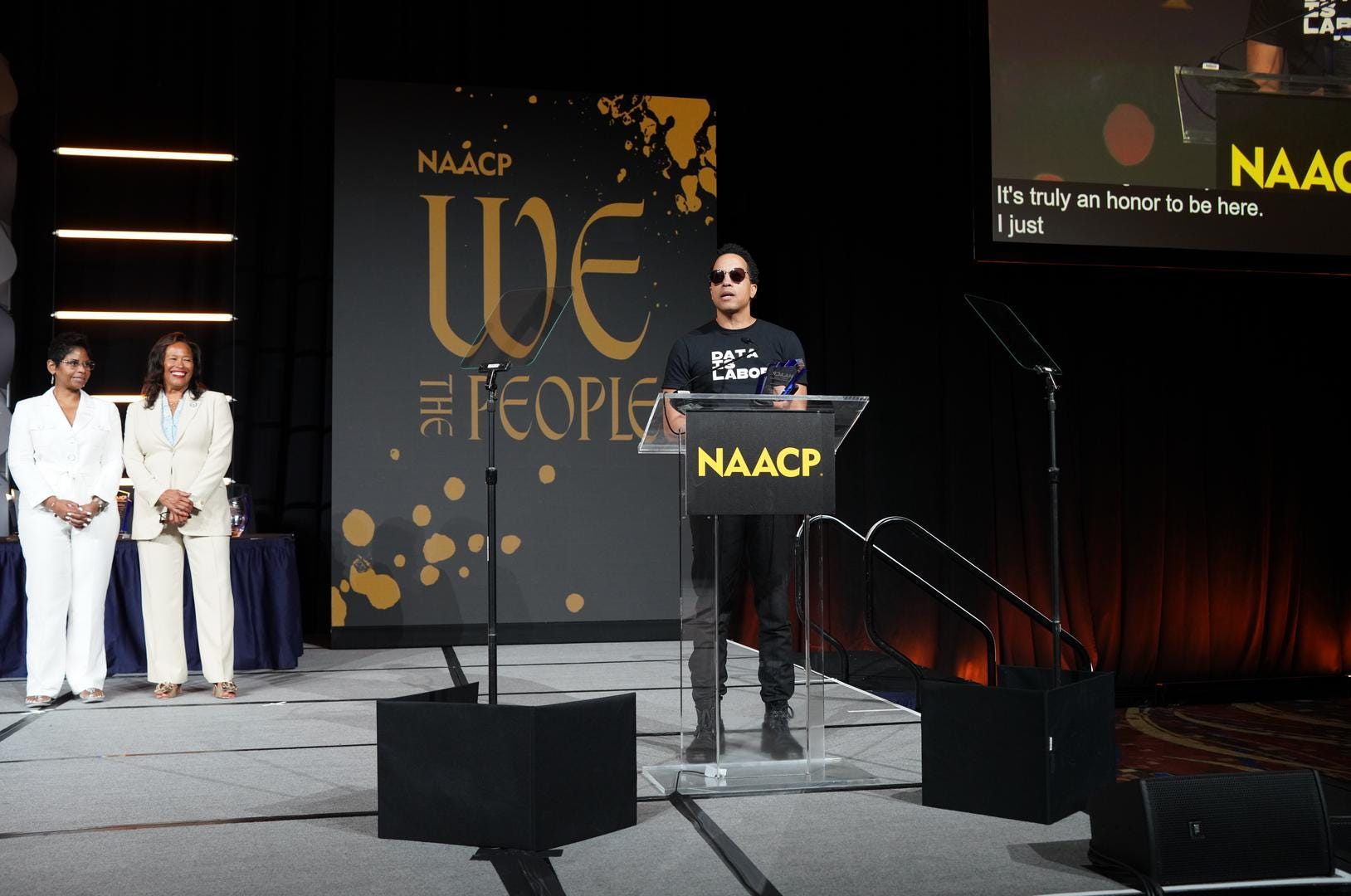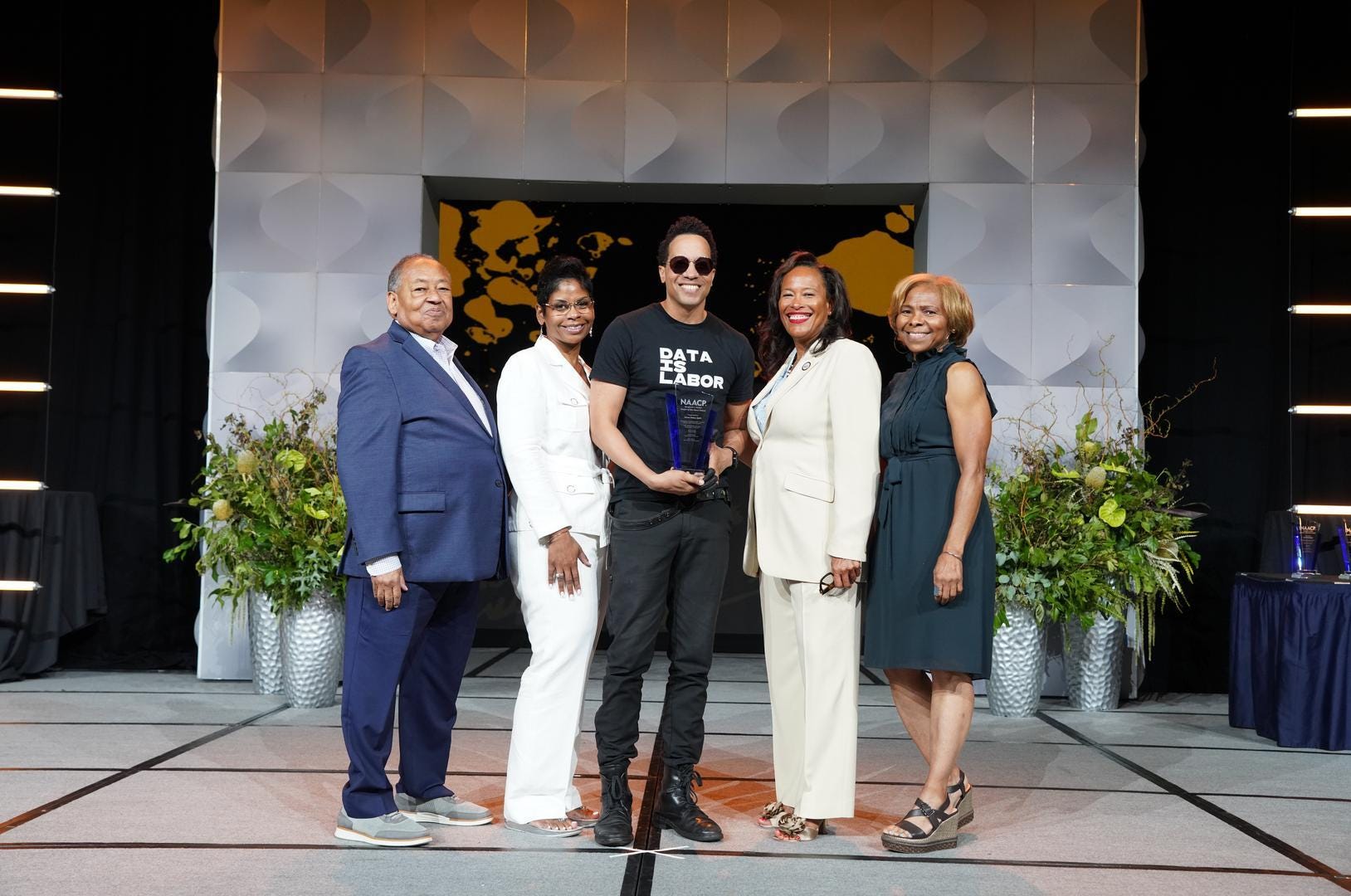
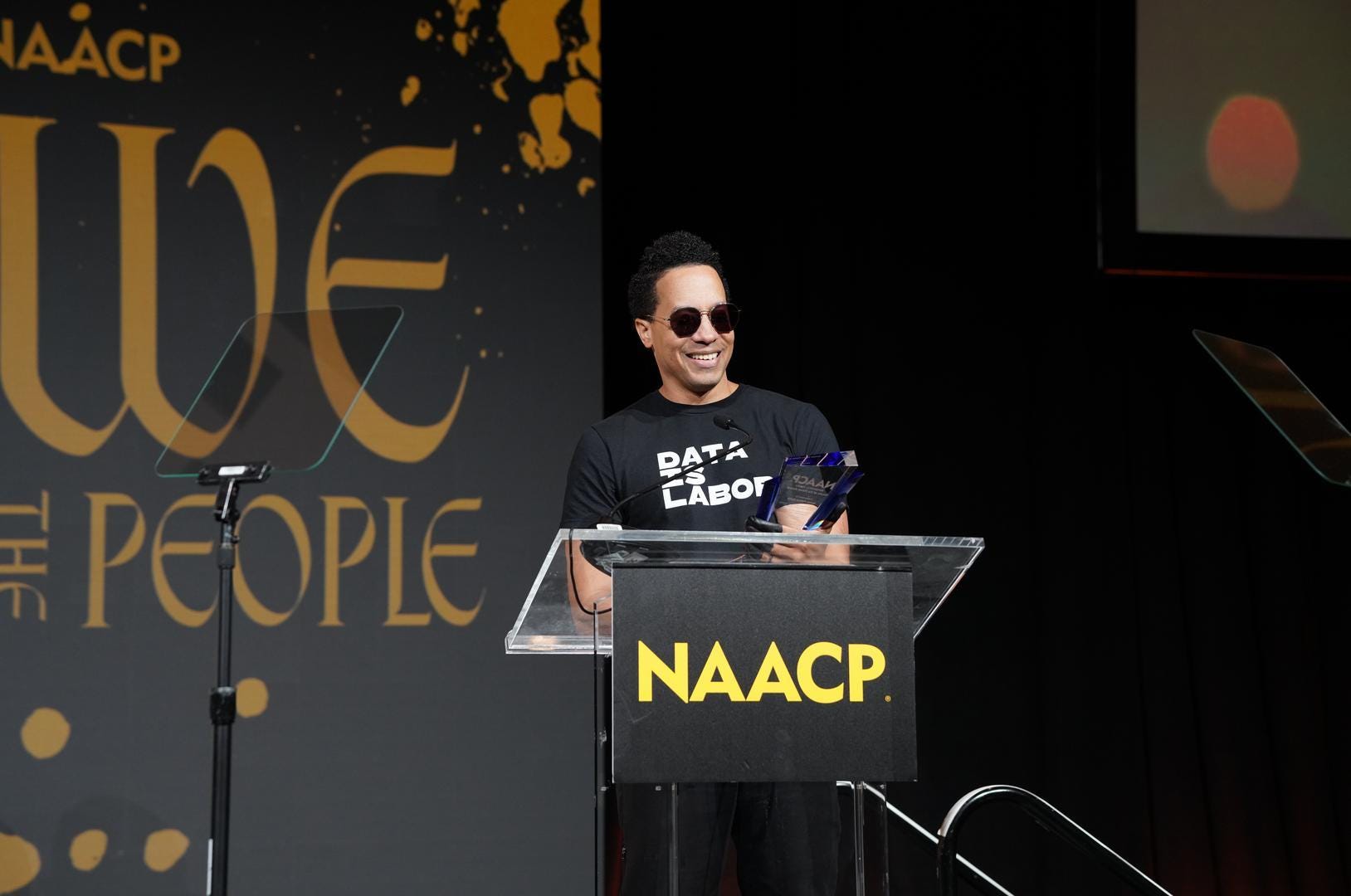
Last week, I stood before hundreds of labor leaders in Chicago to accept the NAACP National Labor Committee’s Keeper of the Flame Award, named in honor of former President and First Black Commissioner of the Federal Communications Commission (FCC) Benjamin L. Hooks. I told them that the foundation Hooks has allowed us to turn all of the data that stems from communications into a type of property that both creates labor and allows us the opportunity to collective bargain for its value. As I stepped off the stage, something unexpected happened.
People didn’t come over to congratulate me.
They came with questions.
“Can our union do this?”
“Can we bargain over AI?”
“How do we make sure our members aren’t giving away everything they’ve taught these machines?”
Those conversations stayed with me long after the luncheon ended.
For more than twenty years, I have argued something that many economists, technologists, and even labor leaders once dismissed as impossible:
Data is labor.
When I first began making that argument, Facebook was still a college website. Smartphones had barely entered our pockets. Artificial intelligence belonged mostly to science fiction. Privacy debates focused almost entirely on surveillance and civil liberties. Very few people were asking who was creating the information that would eventually power an entirely new economy.
Today, no serious person can deny that information has extraordinary economic value.
The largest technology companies in history were built upon it.
The most valuable artificial intelligence systems in the world depend upon it.
Entire industries are reorganizing themselves around it.
The only remaining question is one organized labor has been asking for generations whenever a new source of wealth transforms the economy:
Who should share in the value that workers create?
For most of modern labor history, the answer focused on physical work.
Workers built automobiles.
Workers taught classrooms.
Workers cared for patients.
Workers delivered freight.
Workers answered phones.
Workers wrote books.
Workers performed on stages.
Collective bargaining evolved to ensure that when labor created productive value, labor shared in the wealth that followed.
Artificial intelligence has not changed that principle.
It has expanded it.
Every nurse who documents a patient’s condition is doing more than treating a patient. Every teacher who develops a new classroom strategy is doing more than educating children. Every truck driver who adjusts a route because of weather, traffic, or neighborhood conditions is doing more than delivering freight. Every customer service representative who patiently solves a difficult problem is doing more than helping a customer.
They are all producing information.
For decades, organizations treated that information as little more than documentation—as records of work already completed.
Artificial intelligence has revealed something profoundly different.
Those records are not merely evidence of work.
They have become the raw material from which machines learn to work.
The AI revolution did not invent the value of human knowledge.
It exposed it.
That realization changes the economics of work.
For generations, labor unions negotiated over wages because workers produced goods and services.
Now there is another category of production.
Workers produce informational assets.
Those assets continue creating economic value long after the shift has ended.
A clinical observation recorded today may help train a medical AI system years from now.
A routing decision made by an experienced Teamster may become part of tomorrow’s logistics software.
A lesson developed by an educator may eventually improve an AI tutoring system used by millions of students.
A government employee processing disability claims may unknowingly help shape the next generation of administrative AI deployed across the federal government.
The worker was paid for performing today’s job.
But who is participating in the value of tomorrow’s machine?
That question is no longer philosophical.
It is economic.
And whenever an economic question becomes measurable, it eventually becomes a bargaining question.
For the last several years, my research has focused on a simple challenge.
If workers are creating informational production that artificial intelligence transforms into economic output, then organized labor needs a way to measure that contribution.
Not with slogans.
Not with politics.
With economics.
That is why Keith Institute developed the Human Equivalent Work Unit (HEWU).
HEWU does not attempt to place a price tag on a single email, medical note, lesson plan, customer conversation, engineering drawing, or software commit.
That would be impossible.
Instead, HEWU asks a different question.
How much productive work can artificial intelligence now perform because human beings collectively generated the information from which it learned?
That shift changes everything.
Instead of arguing over the value of one document, we begin measuring the productive capability that millions of documents make possible.
Instead of debating whether data has value, we estimate the amount of labor embodied in the intelligence now performed by machines.
Instead of asking employers to negotiate over abstractions, labor can begin negotiating over documented economic assessments.
For more than a century, employers have arrived at the bargaining table with accountants, economists, productivity analyses, actuarial projections, and financial models.
Artificial intelligence requires organized labor to arrive with something new.
Its own measurement of informational production.
Because the side that measures value usually has the strongest voice in deciding how that value is distributed.
That is why I believe every labor organization—whether it represents teachers, nurses, auto workers, actors, government employees, communication workers, or truck drivers—is becoming something more than the union it has always been.
It is becoming a Data Union.
Not because its mission has changed.
But because the economy has.
From Recognition to Enforcement
Of course, recognizing informational labor is only the first step.
Every labor leader eventually asks the same practical question:
“If our members are creating informational assets, how do we actually protect them?”
The answer is surprisingly familiar.
When we buy a home, we do not carry the house itself into court.
We rely on a deed.
When an inventor defends a patent, they do not recreate the invention from memory.
They rely on a documented record.
When financial markets establish ownership of securities, they rely on registries and clearing systems that independently verify title and chain of custody.
The AI economy needs the same kind of infrastructure for informational assets.
Before information can be valued, licensed, bargained over, or introduced as evidence, it must first be identifiable and independently witnessed.
That does not mean publishing confidential employee records or exposing proprietary employer information.
In fact, doing so would often undermine privacy, confidentiality, and trade-secret protections.
Instead, what is needed is a trusted system that records the existence, provenance, creator, timestamp, and chain of custody of informational assets without publicly disclosing the assets themselves.
Keith Institute has been exploring this model through a partnership with organizations building exactly this kind of infrastructure. One promising example is Made.CX, whose registry architecture demonstrates how informational assets can be independently witnessed, titled, valued, and later licensed or asserted while keeping the underlying information private. Rather than publishing the asset itself, the registry establishes a trusted evidentiary record that can support governance, bargaining, licensing, and, where appropriate, litigation. This mirrors the four-layer framework I’ve been developing for Data Unions: Identification, Witnessing, Valuation, and Assertion.
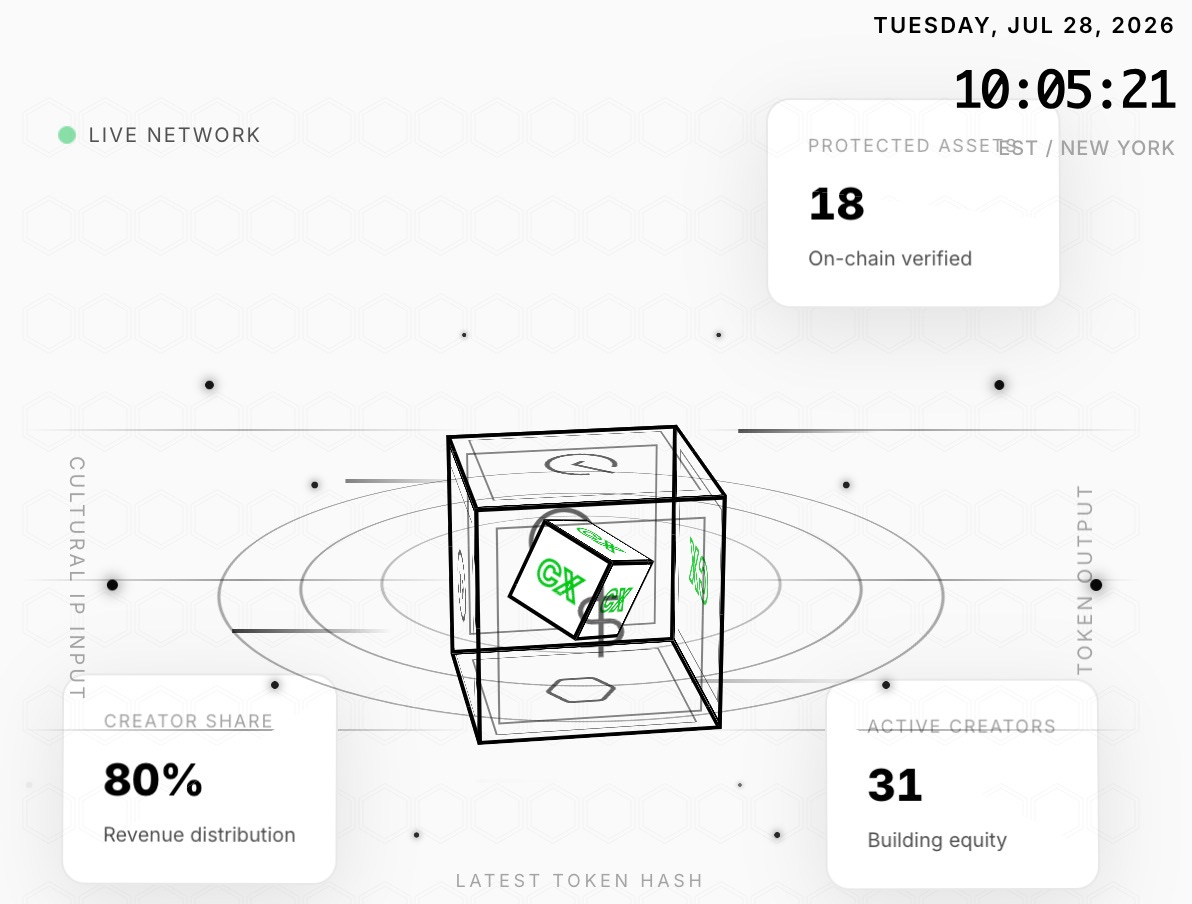
Imagine every union maintaining not only a membership roster, but also a registry of the informational assets collectively produced by its members.
Imagine entering negotiations with documented evidence showing what AI systems rely upon, how those systems were trained, and an independent economic assessment of the continuing labor embodied in those systems.
Imagine asking not simply, “What are wages today?” but, “What continuing value are our members creating tomorrow?”
That is a different conversation.
It is also a conversation organized labor has never been better positioned to lead.
In the days ahead, Keith Institute will begin publishing Data Union Playbooks tailored to individual labor organizations, including the American Federation of Government Employees (AFGE), AFSCME, SEIU, National Nurses United, AFT, NEA, UAW, Teamsters, Communications Workers of America, SAG-AFTRA, the Writers Guild of America, and others. Each playbook will identify the informational assets unique to that profession, map how artificial intelligence depends upon them, estimate their Human Equivalent Work Unit (HEWU), recommend bargaining priorities, and outline practical pathways for implementing a Data Union.
The industrial economy gave rise to the institutions of organized labor.
The information economy demands that we build the next generation of them.
Artificial intelligence has already proven that human knowledge is one of the most valuable productive resources in history.
The question is no longer whether workers create that value.
The question is whether labor will organize around it before someone else decides what it is worth.
The next great chapter in the history of organized labor will not be written by artificial intelligence.
It will be written by the workers whose intelligence made artificial intelligence possible in the first place.