

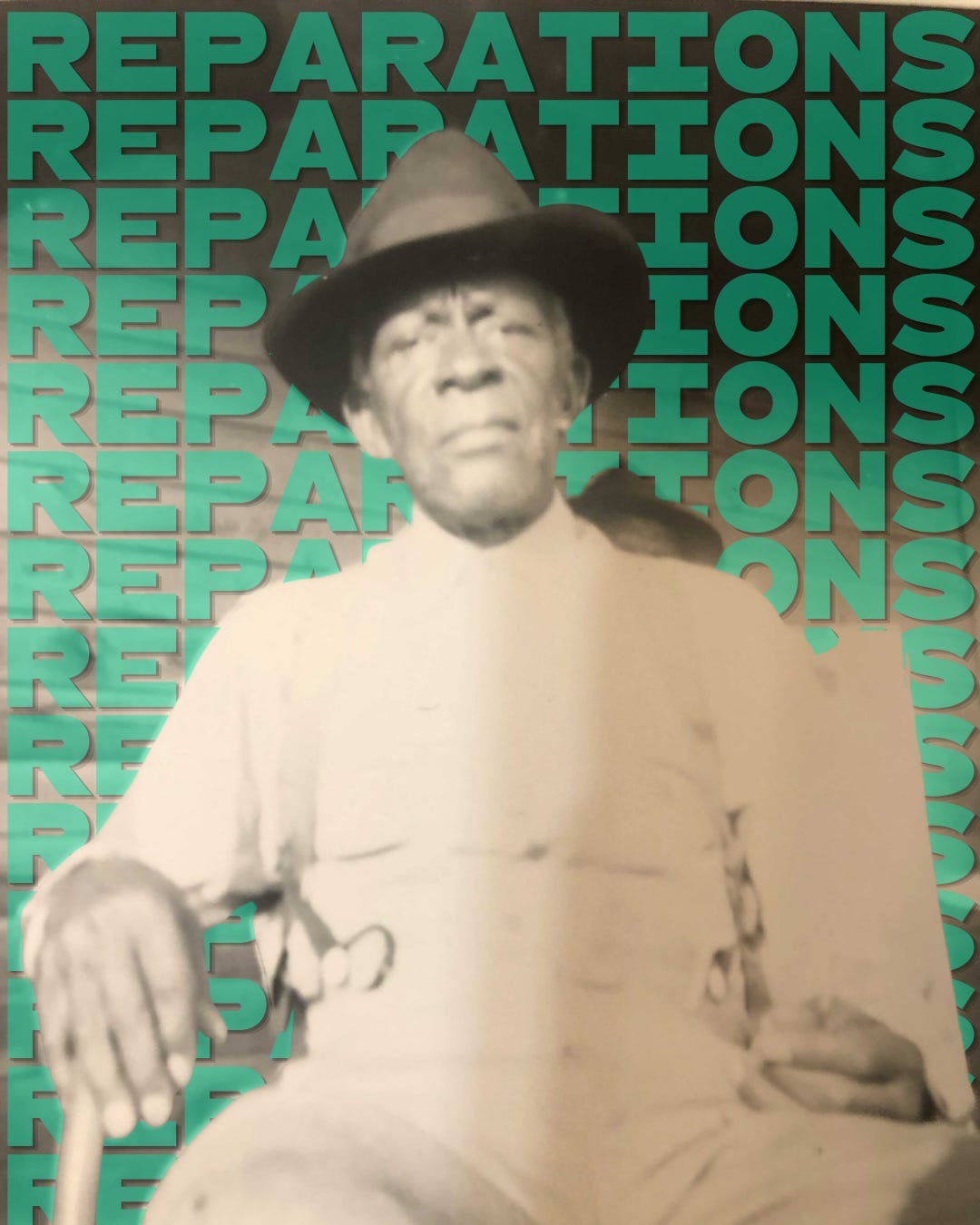
This is James “Papa Jim” Keith, my great-great-grandfather. He was born on September 15, 1871, six years after his parents were emancipated, and was the first James Keith in my bloodline born outside of slavery. He was a sharecropper forced off of his land by gun point which triggered much of his family moving to Newnan Georgia and as far away as Detroit Michigan. I carry his name. So in this essay I am not only asking an economist’s question when I write about: what value survives our contribution, what wealth compounds, what families inherit, and what an unpaid account means across generations… I am writing about a history that sits inside my own name.
I. The Question in Chicago
After Angela Wells, the Human Rights Director of the Communications Workers of America, called my name, I felt the weight of the hundreds of labor organizers in the room.
I was in Chicago to receive the Benjamin L. Hooks Keeper of the Flame Award from the NAACP National Labor Committee. I had prepared remarks about labor, artificial intelligence, and the new forms of value workers produce in an economy increasingly built on information. But somewhere between my seat and the stage, I stopped thinking about the speech I had written and started thinking about the man whose name was on the award.
Benjamin Lawson Hooks had been the first Black commissioner of the Federal Communications Commission. When he arrived at the FCC in 1972, communications meant television stations, radio frequencies, broadcast licenses, telephone networks, and the enormous political question of who was allowed to own and operate the infrastructure through which Americans saw and heard one another. Hooks understood that communications systems were not neutral. Ownership shaped representation. Access shaped power. The ability to speak through the dominant communications infrastructure could help determine who was visible, who was heard, and whose interests entered the national conversation.
More than half a century later, I was standing before a room of labor leaders with an award bearing his name, trying to explain that communications had become something else as well.
They had become assets.
An email is now a data point. A Microsoft Teams conversation is a data point. A customer complaint is a data point. A worker correcting a mistake is a data point. A meeting, a route, a medical decision, a keystroke, a photograph, an exception to a routine, a conversation between two employees trying to solve a problem, all of these can become observations from which a machine learns something about the world.
I found myself wondering what Commissioner Hooks would have thought about that transformation. We spent the twentieth century fighting over who could own the television station. In the twenty-first, the communication passing through the station, the office, the computer, and the worker has itself become a productive asset.
That week, the strange economics of this new world had become almost literal. Google had agreed to pay $10 million in a bankruptcy auction for access to a vast body of Spirit Airlines enterprise data, including roughly 100 million emails and 500 million Microsoft Teams chats, along with other business records. The airline could fail. Employees could lose their jobs or move on. Offices could close. Aircraft could change hands. But the accumulated record of how thousands of people communicated, coordinated, solved problems, made decisions, and operated an airline still possessed enough prospective value that one of the most sophisticated technology companies in the world was willing to bid millions of dollars for access to it.
The workers had already been paid for their work.
What had paid them for what their work had taught the machine?
That was the question I had come to Chicago to put before organized labor. Unions have spent generations developing systems for bargaining over the recognized products and conditions of labor: wages, pensions, benefits, safety, seniority, scheduling, discrimination, layoffs, and the conditions under which human effort is sold. Yet workers increasingly produce another economically consequential input while performing the work for which they are paid. Their decisions, corrections, routes, judgments, conversations, mistakes, patterns, exceptions, and solutions become observations. Those observations can be aggregated. Aggregated information can improve prediction. Better prediction can improve decisions. Better decisions can lower costs, increase revenues, reduce risk, automate tasks, and raise the value of an enterprise.
The wage may compensate the worker for performing the task. It does not necessarily compensate the worker for producing an informational asset that continues to create value after the task has ended.
That distinction is the basis of what I have called Data Is Labor. But over time I came to believe that saying data has value was not enough. Almost everyone in the modern economy now understands that data can be valuable. The more difficult question is whether we can determine what portion of that value comes from the people whose activities produced the information in the first place.
If we can measure that contribution, then something changes. A conversation about privacy becomes a conversation about production. A conversation about consent becomes a conversation about ownership. A conversation about technological displacement becomes a conversation about income. And a worker who has been told to think of himself primarily as a person vulnerable to automation can begin asking whether he is also one of the people who supplied the informational inputs that made the automation economically useful.
I tried to make that case to the labor leaders in Chicago. A union entering negotiations over artificial intelligence should not ask only whether the machine will replace workers. It should ask what the machine learned from workers before it became capable of replacing any portion of their work. It should ask which observations improved the system, what uncertainty those observations removed, how the improvement affected productivity, and where the resulting value appears in the accounts.
When I stepped off the stage, the question came back to me in a form I had not expected.
Theodis Pace, president of the Illinois State Conference of the NAACP, approached me with a group of men. Illinois was itself wrestling with new rules governing artificial intelligence, data, safety, and the rights of the people affected by these systems. But Pace’s question was larger than regulation.
Was this how we get reparations?
The question stopped me because I understood immediately why he had heard reparations inside an argument about information.
I had been describing an economy in which people contribute something productive, institutions accumulate the resulting value, and the prevailing accounting system has no obvious place in which the contributor’s share appears. The worker may be paid for performing a task while simultaneously producing an informational asset whose value accrues somewhere else. The activity ends, but the information remains. The information improves prediction. Prediction improves productivity. Productivity can increase the value of the asset and the institution that owns it. The contributor can disappear while the contribution compounds.
Black Americans have heard some version of that story before.
Chicago was an appropriate place to ask the question.
In 2014, Ta-Nehisi Coates made Chicago one of the central landscapes of “The Case for Reparations.” His essay forced millions of Americans to consider reparations not merely as an argument about slavery, guilt, or history, but as an account. Coates began with Clyde Ross, a Black man who grew up in Mississippi, watched his family’s property taken, moved north, served his country, worked, married, raised children, and attempted to do one of the most ordinary things an American family could aspire to do in the middle of the twentieth century: buy a house.
Ross discovered that Black Americans inhabited a different housing market.
The legitimate mortgage system that helped millions of white families convert wages into equity was largely closed to people like him. Black buyers in Chicago were instead steered toward contract sales that could impose the obligations of homeownership while denying many of its protections. Ross bought a house at a price far above what the seller had recently paid for it. He accumulated no conventional equity as he made his payments. Missing one payment could put everything at risk.
So Ross worked.
His wife worked.
Money that might have gone toward their children’s education, savings, improvements to the house, investments, leisure, or inheritance went instead toward sustaining an arrangement made profitable in part by Black exclusion from ordinary credit.
Coates’s story of Ross begins even earlier, in Mississippi, where the losses arrived in forms a child could understand. Land disappeared. Livestock disappeared. A buggy disappeared. A horse that Ross loved was taken. Later came sharecropping and an economic arrangement in which Black families could do the work while someone else controlled the books.
Ross described the horse as one of his losses.
That word has stayed with me because loss is economically more revealing than inequality.
Inequality tells us where two people stand.
Loss asks how they arrived there.
Loss asks what moved. It asks what existed before, where it went, who received the benefit, what the asset became, what opportunities traveled with it, and what might have happened if the original owner or producer had retained the value.
Those questions are at the heart of reparations. They are also questions of accounting.
The connection I am making to Coates is deliberate. I am not trying to rewrite his case for reparations. I am trying to follow one of the roads his essay opened. Coates showed what happens when extraction is allowed to accumulate across generations and the resulting account is then declared too complicated to settle. I am interested in what happens when we acquire a new ability to observe value while it is being created.
What if we can increasingly measure contribution before it becomes loss?
What if we can identify an unpaid balance before it becomes inheritance?
And what if the institution capable of converting that measurement into power already has a familiar name?
A union.
II. The Account
The American argument over reparations has always had a peculiar relationship with arithmetic. The history is too long, we are told. The injuries are too numerous. The victims have died. The beneficiaries have changed. Money has traveled through generations. Families have migrated, married, invested, inherited, lost, saved, borrowed, and accumulated. Who should receive payment? Who should pay? How much?
These are serious questions. They become evasive only when their difficulty is treated as proof that no account exists.
We rarely apply that standard elsewhere in economic life. Courts estimate the future earnings of people who have died. Insurers price disasters that have not happened. Pension funds estimate how long people who have not yet retired will live. Investors assign present values to enterprises based partly on profits that may not arrive for decades. Antitrust litigation can require economists to estimate what prices might have existed in a market absent unlawful behavior. Patent disputes can require parties to determine how much of a complex product’s value came from one protected invention. Environmental cases can involve damages that unfold across generations. Finance prices uncertain futures. Law reconstructs uncertain pasts. Neither profession requires omniscience before recognizing that a claim may exist.
Yet uncertainty surrounding reparations has repeatedly been treated as if it invalidates the account itself.
Coates confronted this directly. The familiar questions about reparations, who gets paid, how much, and by whom, did not strike him as reasons to abandon the subject. They were reasons to investigate it. His argument for H.R. 40 was in part an argument for opening the books. The political resistance to even studying the account suggested that the threat of reparations was not simply the possibility that someone might eventually receive a check. A serious accounting could disturb the story America tells about where its prosperity came from.
This is because accounting does more than count money. It determines what capitalism recognizes.
A productive contribution can exist without the person making it possessing a recognized claim on the resulting value. That distinction is central to Black American economic history.
The productive value of enslaved people was not hidden from those who enslaved them. It was precisely because their labor possessed enormous value that an elaborate legal, financial, commercial, and political system grew around its extraction. Enslaved people were bought and sold. Their labor supported enterprises. Their bodies themselves could be insured, financed, collateralized, inherited, and entered into accounts. The problem was not that America could not see their economic value. The problem was where the legal claim to that value had been placed.
The worker produced.
The owner accumulated.
Emancipation transformed the legal structure, but it did not automatically reconcile the account. Sharecropping could leave the person producing the crop dependent upon calculations controlled by someone else. Convict leasing transformed criminal law into another source of cheap and coerced labor. Employment discrimination restricted where Black people could work and the wages they could command. Housing discrimination prevented generations of Black Americans from using the same federally supported mechanisms through which millions of white families converted wages into appreciating assets. Contract selling then created a market in which exclusion itself became profitable. Decades later, predatory mortgage lending found concentrated opportunities in communities shaped by the exclusions that preceded it.
These systems were not identical. Their histories should not be collapsed. Slavery is not contract buying. Contract buying is not employment discrimination. A predatory mortgage is not convict leasing. Moral and historical precision matters.
But the differences do not erase a recurring economic structure. People produce value inside institutions that determine who has standing to own, price, transfer, and accumulate it.
Markets do not merely discover value. They operate through rules that determine who can claim it.
Over time, the distribution created by those rules can begin to look natural. The transaction disappears but the asset remains. The law changes but the property remains. The discriminatory mortgage rule is repealed but the house purchased under the earlier rule continues appreciating. The employee retires but the pension remains. The business started with inherited capital continues operating. The neighborhood shaped by decades of disinvestment does not automatically become the neighborhood it might have been if investment had arrived.
History becomes embedded in assets.
This is why Coates’s analogy to a credit-card balance remains useful. A person can stop making new charges without eliminating the old debt. Ending the offending transaction and reconciling the accumulated balance are not the same thing.
Abolition ended legal slavery. It did not distribute the wealth slavery had produced.
Ending redlining did not retroactively give excluded families the houses they might have purchased.
Prohibiting employment discrimination did not create the savings, promotions, businesses, pension contributions, or investments that earlier discrimination had prevented.
The reason is compounding.
Imagine a Black family prevented from buying a house for $20,000 in 1950. If we treat the loss as $20,000, we have misunderstood wealth. The house might appreciate. The accumulating equity might become collateral. The collateral might finance a business. The business might create income. The income might pay tuition. The degree might increase earnings. The earnings might help purchase another house. The house might pass to a child. The inheritance might allow that child to take an entrepreneurial risk that another family could not afford.
The original denial does not remain trapped in 1950.
Neither does the benefit received by the family on the other side of the opportunity.
A transfer changes future possibilities.
Wealth is not only money. Wealth is stored possibility. It is time. It is collateral. It is resilience. It is access to education. It is the ability to endure unemployment. It is the ability to move. It is the ability to wait. It is the ability to start something that might fail. It is the ability to help a child without borrowing. It is political influence, bargaining power, and protection from catastrophe.
This is why reparations cannot be reduced to an argument about whether present-day Americans personally committed a historical wrong. The relevant economic question is not simply who committed the original act. It is what happened to the resulting value.
Someone inherited the asset.
Someone inherited the loss.
The account survived the people who opened it.
That is where my own work on information unexpectedly meets the reparations argument.
Because we are building another economy in which value can be produced by people without a recognized account for their contribution.
But this time something is different.
This time we may be able to measure much of it while it happens.
III. What the Machine Knows
The traditional economic story of production is built primarily around capital and labor. A company acquires capital. It hires workers. Through the combination of the two, it produces output. In simplified form, we can write:

Output is a function of capital and labor.
That model remains useful, but it is increasingly incomplete.
Consider an airline. Aircraft are capital. Employees are labor. Yet profitability also depends upon knowing things: how much passengers will pay, when they will travel, which routes will fill, which flights will remain empty, when maintenance will be required, how weather will affect operations, where disruptions are likely to occur, and how customers will respond to changing prices.
Consider an insurer. It has capital. It employs underwriters, claims professionals, actuaries, salespeople, and administrators. But its economic survival depends upon reducing uncertainty about risk.
Consider a hospital. Buildings and machines are capital. Clinicians and staff are labor. Yet an increasing amount of healthcare production depends upon knowing which patient is likely to deteriorate, which treatment is likely to work, which staffing pattern is sufficient, which claim is likely to be denied, and which combination of observations indicates danger.
Consider the companies building artificial intelligence. They own or rent enormous amounts of computational infrastructure. They employ engineers and researchers. But computation alone does not explain what the system knows.
The system must learn from something.
This is the missing factor.
Information.
More precisely, useful information reduces uncertainty about something that matters.
The concept can be written simply:

The notation is less important than the question behind it.
What did you know before you observed X?
What do you know about Y after observing it?
The difference is information.
Suppose a retailer is trying to predict how many units of a product customers will purchase tomorrow. Without detailed observations, the retailer begins with substantial uncertainty. Add purchase histories, search behavior, geography, weather, timing, promotions, and the behavior of millions of customers, and the uncertainty falls. The retailer can stock inventory more efficiently.
Suppose an insurance company is trying to estimate the probability of a loss. More useful observations can improve the prediction and allow it to price the risk differently.
Suppose a hospital is trying to identify which patient may deteriorate in the next twelve hours. Years of patient histories, clinical decisions, interventions, and outcomes may allow a predictive system to identify relationships that reduce uncertainty.
The economic value lies not merely in possession of data.
It lies in what uncertainty the data removes.
That distinction matters because a vast dataset can be nearly worthless if it tells us nothing relevant to a valuable decision, while a relatively small body of information may be extraordinarily valuable if it makes an expensive uncertainty substantially more predictable.
Once information is understood this way, the production function can be expanded:

Capital.
Labor.
Informational stock.
The third input does not replace the first two. It can make them more productive.
A truck is useful capital. A driver supplies labor. But information telling the driver precisely where demand will be, which roads are congested, which delivery should be made first, and which customer is likely to be absent can allow the same truck and the same worker to produce more output.
Nothing about the truck changed.
Nothing about the worker’s physical capacity changed.
What changed was uncertainty.
The firm knew more.
That additional knowledge had productive value.
This gives us a different way to think about personal and worker-generated data. For years, our public discussion has been dominated by privacy. Did I consent to the collection? Can the company sell the information? Can I delete it? Was it breached? Do I have the right to opt out?
These questions matter enormously.
But privacy does not answer the economic question.
The economic question is: What did knowing something about me allow you to know about something else?
And what was that improvement worth?
A company trying to answer this question does not have to guess blindly. Modern predictive systems are constantly evaluated against one another. A baseline model performs at one level. A model supplied with additional information performs at another. The difference between the two can be measured.
If the initial predictive loss is (L_0), and the predictive loss after adding useful observations is (L_1), then the improvement is:

Again, the equation is not the point.
The point is the counterfactual.
What could the system do without the contribution?
What can it do with the contribution?
That is the beginning of valuation.
Suppose a retailer’s improved prediction reduces wasted inventory by $50 million a year. Suppose an insurer’s improved prediction reduces claims costs by $100 million. Suppose a logistics system reduces fuel and labor costs by $200 million. Suppose an AI system allows a company to perform work that previously required thousands of additional employee hours. Once the relationship between improved prediction and economic output can be established, the informational input can begin to be priced.
This does not mean the calculation will always be simple. Capital is not simple to price. Human capital is not simple to price. Intellectual property is not simple to price. Wrongful-death damages are not simple to price. Insurance liabilities are not simple to price. Economies proceed anyway.
Uncertainty about price is not evidence of zero value.
The more interesting problem is that our current economic accounting often omits the informational factor altogether.
If information contributes to output but the model recognizes only capital and labor, the value produced by information must appear somewhere else. In contemporary firms, informational systems are commonly embedded inside capital-intensive infrastructure. Servers, cloud platforms, software, databases, proprietary algorithms, and artificial-intelligence systems are treated as corporate assets. If the productive contribution of information is not separately recognized, the return produced by that information can appear as a return to the capital that owns the system.
The machine looks more productive.
The platform looks more productive.
The company looks more productive.
Capital’s share rises.
The human beings whose observations helped produce the informational stock disappear from the account.
The issue is not that we do not know information has value.
The Spirit Airlines auction makes that impossible to deny.
A bankrupt company could possess communications valuable enough for another company to bid millions of dollars for them.
The harder question is who produced the thing being sold.
Spirit produced the database as an institution. Its systems preserved the communications. Its servers, contracts, and software made the collection possible. But employees wrote the emails. Employees held the conversations. Employees solved the problems. Employees generated much of the informational substance from which a model might learn.
The asset is institutional.
Its informational content is human.
What portion belongs to whom?
That is no longer merely a philosophical question.
It is becoming a calculable one.
IV. From the Contract Buyers League to the Data Union
This is where I return to Clyde Ross.
The great insight of the Contract Buyers League was not simply that Black Chicagoans had been treated unfairly. Many of the people involved already knew their individual arrangements were unfair. What organization changed was their ability to see the structure.
An isolated homeowner sees one house.
One payment.
One contract.
One seller.
One problem.
That isolation can produce shame. Perhaps I should have read the agreement more carefully. Perhaps I paid too much. Perhaps I made a bad decision. Perhaps I stretched my finances. Perhaps I should simply work harder.
Ross knew this feeling. He had escaped one exploitative economic system in Mississippi and found himself trapped inside another in Chicago. The experience could make a person feel foolish even when the foolishness belonged to the system.
Then people started talking to one another.
One contract was placed beside another.
One purchase price was compared with another.
One seller’s behavior was compared with another seller’s behavior.
The same neighborhoods appeared.
The same financial institutions appeared.
The same patterns of markup appeared.
The same exclusion from ordinary mortgages appeared.
The individual transaction became a dataset.
And the dataset told a different story.
Eventually more than 500 Black homeowners joined the Contract Buyers League. They confronted sellers. They took their case into the neighborhoods where the sellers lived. They withheld payments and placed money into escrow. They sued. Most important, they changed the nature of their claim.
They were no longer asking merely to be treated better in the future.
They were asking what had already been taken from them.
They were seeking restitution.
Coates recognized this as reparations.
The parallel to the informational economy is not that a data user is Clyde Ross or that an employee whose emails help train an AI system has suffered what Black homeowners in Chicago suffered. Those equations would be morally and historically crude.
The parallel lies in the transformation from individual experience to collective knowledge.
One person’s email seems insignificant.
One person’s route seems insignificant.
One nurse’s correction seems insignificant.
One worker’s keystrokes seem insignificant.
One driver’s decision seems insignificant.
One writer’s sentence seems insignificant.
The individual can therefore be told that his contribution is worth almost nothing.
But the company does not want one.
It wants millions.
Informational value often emerges through aggregation. Millions of individually ordinary observations can collectively transform what a system knows.
The same phenomenon that makes the data economically powerful makes the individual contributor economically weak.
That is why the Data Union matters.
A Data Union should not be understood simply as a marketplace where individuals sell fragments of personal information for small payments. That conception accepts the company’s unit of analysis and then asks contributors to negotiate alone.
The larger function is collective legibility.
An individual knows what he did.
A Data Union can discover what the population produced.
What information did workers collectively generate? Which systems consumed it? Which vendors received it? Which models were trained on it? What predictions improved? What did those models know before receiving the information? What did they know afterward? What savings resulted? What new revenues became possible? What work could now be automated? What risks became easier to price? What intellectual property emerged? What derivative products were created? How long does the resulting informational stock continue producing value?
These questions transform the discussion.
The worker is no longer simply a person objecting to surveillance or fearful of automation.
The worker becomes a potential claimant on the production process.
This is an important difference.
Organized labor has entered much of the artificial-intelligence debate defensively. Management proposes automation, and labor seeks job protection. Management introduces surveillance, and labor seeks limitations. Management deploys algorithms, and labor asks for transparency. Management introduces an AI system, and labor demands that a human remain involved.
All of those protections matter.
But they begin after ownership has largely been decided.
The company owns the machine.
The company owns the data infrastructure.
The company owns the model.
The company owns the productivity improvement.
The worker negotiates about consequences.
The informational-factor framework allows labor to move upstream.
Before asking what the AI will do to the worker, ask what the worker did for the AI.
A nurse spends years inside a hospital making decisions. She recognizes subtle patterns. She corrects records. She knows when an alarm matters and when it does not. She notices when the data on a screen fails to describe the person lying in the bed. She escalates cases. She communicates with physicians. She watches outcomes. Thousands of nurses generate similar observations over millions of encounters.
Then a hospital or vendor builds a predictive system using some portion of this historical record.
The ordinary labor questions appear quickly. Will the system replace nurses? Will it surveil them? Will it make mistakes? Who will be liable?
The informational question comes earlier.
What did the system know before it encountered the accumulated history of the workforce? What did it know afterward? If the improvement reduced adverse outcomes, what was that worth? If it lowered malpractice exposure, what was that worth? If it allowed the hospital to treat more patients with the same workforce, what was that worth? If the vendor could sell the resulting system to hundreds of hospitals, what was that worth? If the system ultimately allowed fewer people to perform work previously done by more people, what was the value of the knowledge that made the automation possible?
The informational supply chain can be traced.
Human activity becomes observation. Observation becomes data. Data becomes informational stock. Informational stock reduces uncertainty. Reduced uncertainty improves decisions. Better decisions create economic output.
At every step, ownership can change.
The worker who generated the original information may possess no continuing claim at all.
This is where collective bargaining becomes more than a defensive institution. Once informational contribution is measurable, labor can bargain over the factor share.
Suppose a system produces $100 million in annual measurable economic benefit through some combination of increased revenue, reduced losses, automation savings, greater throughput, better asset utilization, licensing, or improved risk prediction. Suppose analysis establishes that a meaningful portion of that improvement depends upon informational stock generated by workers.
There is no law of economics stating that the workers’ informational share must be zero.
Zero is not nature.
Zero is an allocation.
A union could bargain for a share of the value. The share might be paid directly. It might fund pensions. It might finance retraining or automation-transition benefits. It might create residual payments. It might capitalize a worker-controlled Data Union. It might create an ownership interest in the derivative system itself.
The form of payment is a bargaining question.
The conceptual breakthrough comes earlier.
Something that had been treated as free is recognized as a productive input.
That recognition creates agency.
This is the deeper relationship between the Contract Buyers League and the Data Union. Organization creates the ability to see the asset collectively. Once the asset becomes visible, the group can create a claim around it.
The contract buyers had to discover that they were not simply hundreds of unlucky homeowners.
They were an economic constituency.
Workers producing informational stock must make the same discovery.
V. Reparations in Real Time
And so I return to the question Theodis Pace asked me in Chicago.
Is this how we get reparations?
My answer begins with no.
Black American reparations is a particular historical claim. It cannot be replaced by a universal data dividend. A payment for worker-generated information does not compensate descendants of American slavery. A Data Union agreement does not restore land stolen from Black families. An artificial-intelligence royalty does not recreate decades of home equity denied through discriminatory housing policy. A universal program can be just and still fail to address a specific injury.
Coates understood the danger of dilution. America has often taken problems produced by specifically anti-Black institutions and translated them into generalized programs for poverty or inequality. Those programs can help people and still avoid the account that Black Americans are presenting.
There can be more than one account.
A white worker and a Black worker may both possess a contemporary claim if their informational contributions improve an AI system.
The Black worker may also belong to a population holding a separate historical claim against institutions that extracted wealth from Black Americans or systematically blocked its accumulation.
Recognition of the first claim does not extinguish the second.
But my answer to Pace is also yes.
Not because Data Is Labor replaces reparations.
Because reparations teaches us what happens when productive contribution is permitted to become somebody else’s accumulated wealth without a recognized claim from the people who produced it.
Black history demonstrates, with unusual clarity, that lack of payment does not imply lack of value.
The enslaved worker’s labor had enormous value while the worker received none of the return.
The family excluded from the mortgage system did not fail to create value because another family captured the appreciation.
The contract buyer did not cease contributing economically because the seller controlled the terms.
In each case, institutions determined where the accumulated value would reside.
Reparations is therefore, among many other things, retrospective accounting.
It looks at the inherited distribution of assets and asks what transactions, exclusions, extractions, and unpaid contributions helped produce it.
The informational economy creates the possibility of prospective accounting.
We can ask while the system is operating.
What was contributed? What changed because of the contribution? How much uncertainty disappeared? How did the reduction affect output? Who supplied the information? Who accumulated the return?
That is what I mean by reparations in real time.
I do not mean that every unpaid contribution is a reparations claim. I mean that one of the great lessons contained in the reparations argument is that an unpaid economic balance does not become less real merely because society ignores it. Given enough time, it becomes harder to measure, harder to attribute, harder to recover, and easier to mistake for the natural distribution of wealth.
The informational economy gives us the possibility of refusing that delay.
Imagine if the Contract Buyers League had possessed the information infrastructure available today. Imagine every contract buyer being able to see, in real time, the seller’s acquisition price, the resale price, the contract terms, the property value, the financing structure, the default rates, the identity of the banks, and the outcomes for hundreds of other Black purchasers. The data alone would not have produced justice. Power would still have mattered. Law would still have mattered. Organization would still have mattered.
But the system could have become visible earlier.
Extraction depends partly upon invisibility.
The individual sees his problem.
The institution sees the system.
This informational asymmetry is itself a source of power.
The Data Union can reverse part of it.
This is why measurement matters, but also why measurement is not enough.
An equation cannot organize anyone.
A model can estimate informational contribution. It cannot force an employer to bargain.
A dataset can reveal a pattern. It cannot by itself create standing.
People require institutions capable of acting on what measurement reveals.
That is what unions have always done.
The traditional union converts individually weak sellers of labor into a collective bargaining unit.
The Data Union converts individually weak producers of information into a collective informational constituency.
Both begin with the same recognition: what appears insignificant when isolated can become powerful when aggregated.
And that recognition requires something deeper than technical knowledge.
It requires faith in collective value.
The phrase may sound spiritual, but it is fundamentally economic.
The contract buyer had to stop believing that his struggle reflected only his own failure.
The worker must stop believing that because a single datum is worth little, the informational system built from millions of contributors therefore belongs economically only to the owner of the machine.
Capital never applies this logic to itself.
A single investor may own a tiny fraction of a corporation. No one therefore concludes that the investor has no claim.
Capital pools ownership.
Capital aggregates.
Capital creates institutions that persist through time.
Capital receives residual income from assets long after the people who originally assembled them have moved on.
Modern capitalism is extraordinarily collective when capital organizes itself.
It becomes strangely individualistic when people organize claims against capital.
A Data Union restores some symmetry.
If informational value emerges through aggregation, then the people producing the information may also need to aggregate their claim.
This is why labor’s AI strategy should not stop at preserving jobs.
Preservation is defensive.
Ownership is generative.
The question is not only whether the machine will take the job.
The question is what the worker contributed to the machine, what that contribution was worth, and whether the worker retains any claim on the value after the system begins producing on its own.
For the first time, we are building an economy capable of tracing much of this in real time.
A model can be evaluated before and after a dataset.
A dataset can be tested with and without particular categories of information.
Predictive performance can be measured.
Economic outcomes can be compared.
Marginal contribution can be estimated.
The same companies that tell us contribution is too complicated to value routinely measure which advertisement produced a sale, which recommendation increased engagement, which route reduced fuel use, which model improved prediction, which employee increased throughput, and which system reduced losses.
Modern capitalism does not lack measurement.
It lacks an accounting category for the person whose informational contribution sits underneath the measurement.
That is a choice.
And choices can be changed.
VI. Who Gets to Open the Books?
When I think back to that moment in Chicago, I no longer hear Theodis Pace’s question as a request for an equation that can calculate the reparations check.
No equation can settle America’s account with Black people by itself.
I hear a more consequential question.
Have we discovered a new way to see economic value?
Can the technologies being used to observe, classify, predict, automate, and monetize people be turned around and used to reveal what those people contributed?
Can workers who have been described as employees, users, patients, riders, creators, consumers, and data subjects begin to understand themselves as producers of an informational factor?
Can a union demand not simply protection from an artificial-intelligence system, but an accounting of what that system learned from its members?
Can collective organization turn measurement into standing, standing into bargaining, and bargaining into ownership or income?
These are new questions, but they carry an old American rhythm.
Who produced? Who accumulated? Who controlled the account? Who was permitted to own? Who inherited?
Clyde Ross began with his losses. The losses looked personal until he found other people carrying losses that looked remarkably similar. Their stories became data. The data revealed a pattern. The pattern created an organization. The organization created a claim. The claim changed the meaning of what had happened to them.
A bad contract became a system.
A private humiliation became evidence.
A group of buyers became a constituency.
And a demand for fair treatment became a demand for restitution.
That movement from isolation to recognition is the part of Coates’s story I keep returning to.
It is also why his case for reparations remains relevant to an economy he could not have been writing about in 2014.
The informational economy is making human activity legible at extraordinary scale. Our movements, judgments, conversations, preferences, mistakes, corrections, relationships, and patterns are increasingly rendered as observations capable of improving machines. Firms can aggregate them, model them, preserve them, transfer them, and convert them into productive assets.
We should not be surprised that the resulting assets are valuable.
We should be surprised that we have constructed so little economic infrastructure around the people who supplied them.
The question facing us is whether we will wait.
We could allow the machine to absorb its human history and then treat ownership of the machine as ownership of everything the machine learned.
We could allow millions of ordinary human contributions to become privately owned informational fortunes while explaining to every individual contributor that his particular contribution was too small to matter.
We could let informational assets accumulate, be sold, licensed, inherited, financed, and folded into the market value of corporations while the people whose lives generated the underlying observations remain economically invisible.
And then, decades from now, when the distribution is entrenched and the records are incomplete, another generation can begin the familiar argument.
Who was harmed? Who benefited? Who should pay? How much? How could we possibly calculate it now? Black America knows that argument.
It knows the distance between contribution and ownership. It knows how quickly an economic arrangement can become a social fact, how quickly a social fact can become an inheritance, and how easily an inheritance can lose the history of how it was acquired. It knows what happens when a system tells the people creating value that the value is somewhere else, in the landowner, in the contract, in the bank, in the property, in the corporation, in the machine.
Reparations asks us to reopen those accounts after the value has traveled through history.
The informational economy gives us a chance to open the account before history closes over it.
That is the possibility I could not stop thinking about after leaving the stage in Chicago.
Benjamin Hooks had entered the FCC in an era when the struggle over communications was partly a struggle over who had access to the machinery of speech. Half a century later, speech itself has become machine-readable property. An email written by a worker can outlive the company that employed him. A conversation can become training material. A judgment can become a model. A pattern of labor can become automation. Human experience can be captured, aggregated, and transformed into an asset owned by someone who never lived it.
Perhaps Hooks would recognize the underlying question.
Who gets to own the means through which human beings become economically legible?
That question belongs to labor now.
The worker performs an action. The system observes. Uncertainty falls. Prediction improves. Economic value rises. We can increasingly measure the difference. We can trace the contribution. We can identify the population from whom the information came. We can organize those contributors and give them standing to bargain over the wealth that follows.
We do not have to wait until the transaction becomes a grievance, the grievance becomes history, the history becomes inequality, and the inequality becomes an inheritance whose origins society claims are too complicated to recover.
That is the great lesson Black America can offer the informational age. Not that every contemporary economic injury is equivalent to the injuries for which Black Americans seek reparations, and not that a data payment could ever settle America’s racial debt, but that value does not disappear when the person who produced it is denied a claim. It travels. It compounds. It becomes property. It becomes power. It becomes somebody’s inheritance.
The account remains, whether we choose to recognize it or not.
For generations, reparations has asked America to look backward and reckon with where the wealth went.
Our new capacity gives us another choice.
We can see the contribution while it is still being made. We can measure what changed because a human being was observed. We can determine what uncertainty was removed, what prediction improved, what decision became more profitable, and what wealth followed. We can find the people whose collective lives produced that difference. We can give them standing. We can let them organize. We can let them bargain.
And perhaps the most important thing we can learn from the long American argument over reparations is that there is no wisdom in waiting for a debt to become history before admitting that somebody owes it.
James, your message is important - data rights, labor economics, Inclusionism, that's real substance most creators don't have. But the channel isn't reflecting that yet. The videos aren't formatted as proper Shorts, there's no consistent edit style, and it's showing in the numbers.
That's fixable, and it's exactly what I do. I'm a video editor - 260K+ views delivered, took one channel from 12K to 14.3K followers, ⭐ 5-star Top Rated on Upwork. I build a proper Shorts format and edit template around your content so the hook actually stops the scroll and the message gets seen, instead of getting lost.
Happy to take one of your existing clips and do a free sample re-edit, so you can see the difference on your own content before deciding anything.
Worth a look?
chavadihindlaanjali@gmail.com