


People ask, “What do you do?” even though I constantly plaster it on social media. This past week, I was answering a more specific question: How can insurance become an economic instrument for protecting human agency in the age of artificial intelligence?
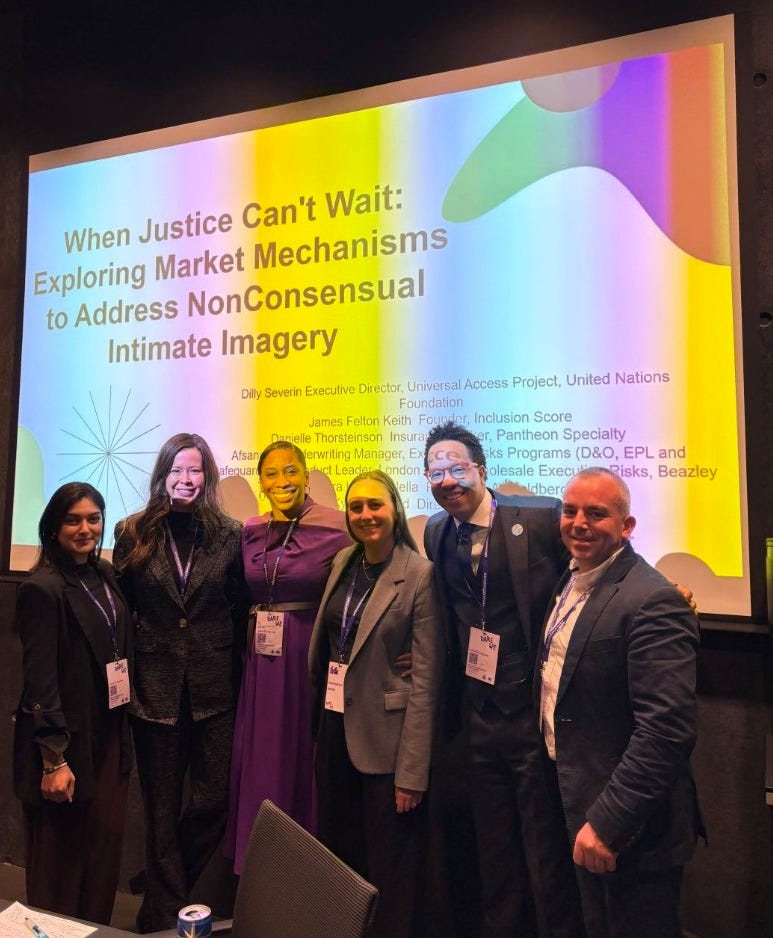
Last week, I returned from the Reykjavík Global Forum in Iceland, and while it was a Chatham House Rules meeting, here is what I can say. I invited a few insurance colleagues to make participated and make the financial case in a discussion about one of the most rapidly scaling threats to the agency of women and girls: nonconsensual intimate imagery (NCII).
The proliferation of artificial intelligence has made the creation, manipulation, and distribution of intimate imagery increasingly inexpensive. Meanwhile, the financial, professional, psychological, and social costs of that abuse remain disproportionately concentrated on the people whose agency has been violated.
This is not simply a technological problem. It is an economic problem.
At InclusionScore, we have been exploring a fundamental question: What if we could make the violation of human rights economically irrational?
The Economics of Agency
Much of our approach to human rights relies on legislation, litigation, advocacy, and education. These are essential instruments of social change, but they frequently operate after harm has occurred. Justice can take years, while the consequences of a violation can materialize in minutes.
Insurance introduces another mechanism.
The insurance industry has historically helped change institutional behavior by attaching financial consequences to risk. From workplace safety and professional liability to cybersecurity and sexual abuse prevention, insurance can influence how organizations invest in protecting people.
When an institution’s failure to safeguard people increases its exposure to financial loss, prevention becomes an economic consideration rather than merely a moral aspiration.
What if we applied that same logic more deliberately to human agency?
Insuring Against the Loss of Agency
Consider a woman who entrusts her mobile phone to a commercial establishment, only to discover that someone has accessed and distributed her private photographs. Consider a young woman whose likeness has been manipulated by artificial intelligence to create sexually explicit imagery that never existed. Consider the educational, professional, and economic opportunities that either could lose as a result.
Who finances their recovery? Who pays for the lawyers, therapists, digital removal specialists, emergency accommodations, and restoration of their professional reputations? And what financial incentives exist for the institutions capable of preventing these harms?
At InclusionScore, we are developing an insurance framework that approaches these questions from two directions: institutional accountability and individual protection.
The institutional component explores how safeguarding and liability insurance can incentivize organizations to implement measurable prevention and response mechanisms. The individual component explores how personal cyber insurance and specialized recovery benefits can provide survivors with access to resources without waiting for years of litigation.
Existing insurance markets offer foundations for both approaches. The opportunity is to address the gaps between them.
We call this emerging initiative ShieldHER.
From International Standards to Financial Instruments
Our work at InclusionScore has historically focused on translating international management standards into measurable institutional practices. Through our work in human resource management, diversity and inclusion, and artificial intelligence management, we have developed methodologies for assessing how organizations govern their responsibilities to people.
Through Inclusion Brokerage Services, we are exploring how these assessments can inform the development, distribution, and underwriting of insurance products.
This represents an important evolution in our business.
An institutional assessment should not simply tell an organization whether it is doing well or poorly. It should create information that markets can use. That information can potentially influence insurance premiums, contractual requirements, procurement decisions, liability exposure, and the cost of doing business.
When responsible institutional behavior becomes financially advantageous, human rights protection becomes part of the economic infrastructure of an organization.
The Role of Government
Governments also have an important role in creating the conditions for these markets to develop.
Legislation can establish safeguarding obligations, strengthen civil remedies, recover profits generated through unlawful conduct, and create survivor recovery funds. Insurance regulators can examine coverage gaps and facilitate responsible product innovation. Public procurement authorities can incorporate appropriate safeguarding requirements into commercial relationships.
Together, these mechanisms can create a system in which prevention is less expensive than negligence, exploitation carries meaningful financial consequences, and survivors have access to resources when they need them.
Insurance cannot replace justice. But it can help finance recovery while creating additional incentives for institutions to prevent harm.
Financializing Human Rights
I have spent much of my career arguing that human interaction produces economic value and that the recognition of that value is fundamental to individual agency.
The inverse is also true. When agency is taken away, economic harm can occur.
Our challenge is to build institutions capable of recognizing that harm, financing recovery, and creating meaningful consequences for those responsible.
At InclusionScore, we believe the intersection of international standards, risk assessment, insurance, and public policy represents an emerging market for doing precisely that.
We are not trying to put a price on human dignity. We are trying to make the failure to protect it impossible to ignore.
Perhaps the next frontier of human rights is not simply establishing what people are entitled to, but building the financial infrastructure that makes those entitlements enforceable.