From Detroit to NYC to Chicago: Why Labor Must Bargain for the Information Economy
On June 3, 2015, I stood before Local 2499 of the National Border Patrol Council in Detroit. I had been invited there not as a labor economist, but as a civil rights leader. As the founding CEO of the Detroit LGBT Chamber of Commerce, I was being recognized for my 2014 commitment to diversity and inclusion and for helping build bridges between communities that, historically, had not always found themselves in the same room. It was a meaningful moment. An LGBTQ human rights advocate receiving recognition from a Border Patrol union would have seemed unlikely only a few months earlier. Having been detailed and threatened with arrest by that same patrol, I was proud of what that event represented.
Then I changed the subject.
At least, that’s what many people in the audience thought.
During my remarks, I began talking about the changing economics of the American middle class. I argued that what we traditionally understood as a middle-class standard of living increasingly required household incomes approaching $200,000 a year. Before I could explain why, someone shouted from the audience, “What does that make us?” Others joined in. The room became animated, not because people disagreed with mathematics, but because they believed I had questioned the dignity of their work.
Afterward, my mother, an SEIU steward who had accompanied me on the trip while visiting the city where she lives, offered me advice that has stayed with me ever since.
“Maybe don’t begin your next speech by telling people who work every day that they’re poor.”
She was right.
Those Border Patrol agents were not looking for an economics lecture. They were doing exactly what America had promised would lead to stability. They had chosen public service. They belonged to a union. They worked difficult jobs under demanding conditions. They believed that honest work, fairly compensated, would provide security for their families.
The problem was never their work.
The problem was that I had started with the conclusion before explaining the transformation that had produced it.
Looking back, I realize I was trying to describe a problem before I fully understood its cause. More importantly, I was trying to introduce an idea before the economic language existed to explain it. Many people believed I had wandered off topic. In hindsight, I think I had simply arrived early.
Over the next decade, that moment in Detroit became one of the experiences that shaped my research. I wanted to answer a question that I could not answer satisfactorily that afternoon: if workers continued becoming more productive, why did so many feel that economic security was slipping further away? Why did the promise that “a good-paying job” would build a middle-class life seem increasingly out of reach, even for union workers and public servants?
Today, the numbers tell part of the story. A salary of $100,000 in 2026 has roughly the same purchasing power as approximately $51,500 had in the year 2000. In one generation, the purchasing power of wages has effectively been cut in half. Even that comparison understates reality because it relies on average inflation. Housing, healthcare, childcare, insurance, and higher education have risen faster than overall consumer prices, meaning that many working families experience an even greater decline in their effective standard of living.
It is therefore understandable that so many Americans say, “A hundred thousand dollars isn’t what it used to be.” They are not imagining the problem.
But inflation alone cannot explain what has happened.
If rising prices were the entire story, then productivity and wages should still be moving together over the long run. Instead, we have watched organizations become extraordinarily more productive while many workers—whether they wear uniforms, steel-toed boots, scrubs, business suits, or name badges—find themselves negotiating over a shrinking share of the value they help create.
The explanation, I believe, is that the economy has quietly changed the nature of production itself.
For more than a century, labor negotiations focused on wages because labor was understood to be the principal human contribution to production. That framework made sense in an industrial economy. A worker exchanged time and skill for compensation, and collective bargaining sought to ensure that workers received a fair share of the wealth their labor produced.
The twenty-first-century economy operates differently.
Today, organizations learn.
Every interaction makes them smarter.
Every customer teaches them.
Every employee teaches them.
Every citizen teaches them.
Every patient, student, driver, shopper, traveler, and public servant teaches them.
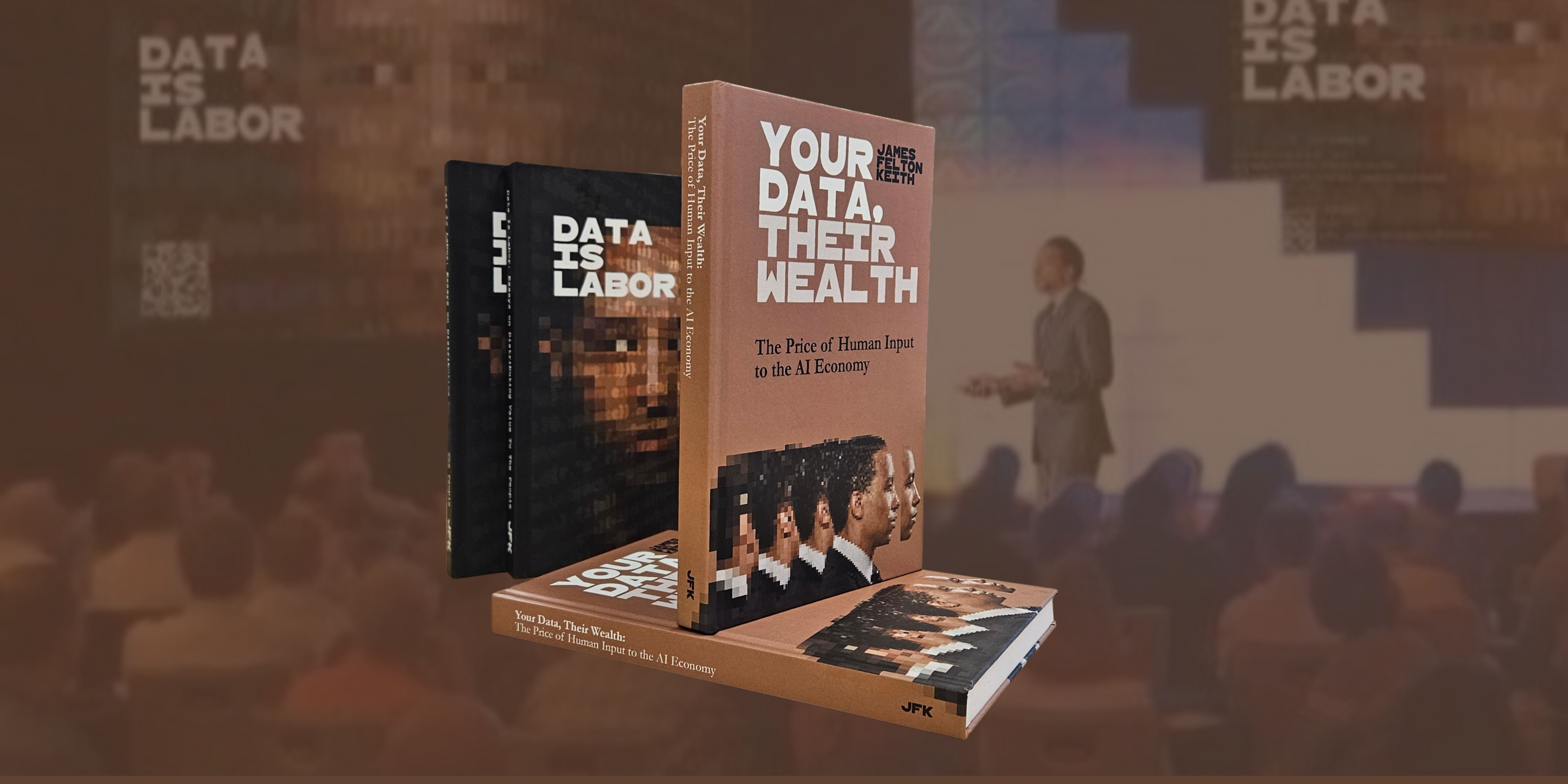
In Your Data, Their Wealth, I argue that these informational contributions have become a distinct factor of production. Every search query, workplace decision, GPS route, customer interaction, case file, software correction, medical diagnosis, inspection report, transaction, or conversation reduces uncertainty somewhere inside an organization. That reduction of uncertainty makes organizations more productive. It improves forecasting. It enhances artificial intelligence. It strengthens risk models. It optimizes logistics. It reduces fraud. It accelerates innovation. It lowers operating costs. In short, it creates wealth.
This is why I describe data as labor.
Not because data replaces labor, but because information has become productive work.
The remarkable feature of this transformation is that it is not limited to technology companies. It affects nearly every organization in modern society. A software engineer trains development systems. A retail worker improves inventory forecasting. A plumber helps identify maintenance patterns. A nurse contributes to clinical decision-making. A teacher improves educational systems. A Border Patrol agent generates operational intelligence. A police officer contributes public safety information. A sanitation worker improves municipal routing. Whether someone works for a private corporation, a nonprofit organization, a city government, a school district, or the federal government, their daily work increasingly produces not only immediate labor but also lasting informational assets that organizations retain and continue using long after the work itself has ended.
This is the economic reality that connects a unionized federal officer in Detroit to a warehouse worker in Memphis, a public-school teacher in Chicago, a nurse in Atlanta, a construction worker in Phoenix, and a software developer in Seattle. They perform different jobs, work for different employers, and belong to different unions—if they belong to one at all—but they increasingly contribute to the same kind of productive asset. They reduce uncertainty. They generate knowledge. They help organizations become more efficient, more predictive, and more profitable through the information embedded in their work.
The distinction between the public and private sectors, while important for governance, matters far less than we often assume when we examine how modern productivity is created. Public agencies increasingly rely on predictive analytics, artificial intelligence, digital records, and operational intelligence generated by their employees and the communities they serve. Private firms rely on similar informational systems. Both become more productive by learning from human contribution. Both accumulate informational capital. Yet compensation systems in both sectors continue to recognize primarily the labor performed rather than the informational assets created.
That is why I no longer believe that “good-paying jobs” are sufficient by themselves.
Good jobs remain essential.
Higher wages remain essential.
Strong unions remain essential.
But if workers now contribute both labor and information, then collective bargaining must evolve to reflect both forms of contribution.
The labor movement transformed the industrial economy because it recognized that workers deserved a fair share of the value created through their labor. The information economy demands a similar evolution. Contributors should receive recognition, attribution, participation, and ownership for the informational assets that increasingly power artificial intelligence, insurance, finance, healthcare, logistics, manufacturing, and government itself.
This is not an argument against technology. It is not an argument against artificial intelligence. It is an argument for ensuring that the people who make those systems valuable participate in the value they create.
When those Border Patrol agents asked me in Detroit, “What does that make us?” I did not yet have the language to answer them. Today I believe I do.
It does not make working people less valuable.
It makes our economic accounting incomplete.
We have continued measuring labor as though work ends when a shift ends. In reality, modern work continues creating value long after the worker has gone home because organizations retain, analyze, and monetize the informational assets generated through human activity. Our compensation systems have not kept pace with that transformation.
The challenge before organized labor, therefore, is not simply to negotiate higher wages within an industrial framework. It is to build a bargaining framework capable of governing the information economy itself.
Eleven years after that afternoon in Detroit, I will stand before another labor audience at the NAACP National Labor Awards in Chicago on July 22. This time I do not intend simply to describe the problem. I intend to propose what I believe is the next evolution of collective bargaining—one that expands beyond wages, benefits, and working conditions to include informational contribution, data rights, AI governance, attribution, and ownership. The speech I gave in Detroit asked a question before the labor movement had the vocabulary to answer it. The speech I will give in Chicago is my attempt to help build that vocabulary.
The future of the American middle class will not be secured by wages alone. It will be secured when we recognize that human beings now contribute two forms of productive value: the labor we perform and the information we generate. If organizations increasingly derive their wealth from both, then justice requires that workers share in both. Good-paying jobs built the last American middle class. Building the next one will require a new social contract—one that recognizes that our data has become their wealth, and that the people who create that wealth deserve an equitable share in its future.