

New York Cannot Afford to Wait for Itself
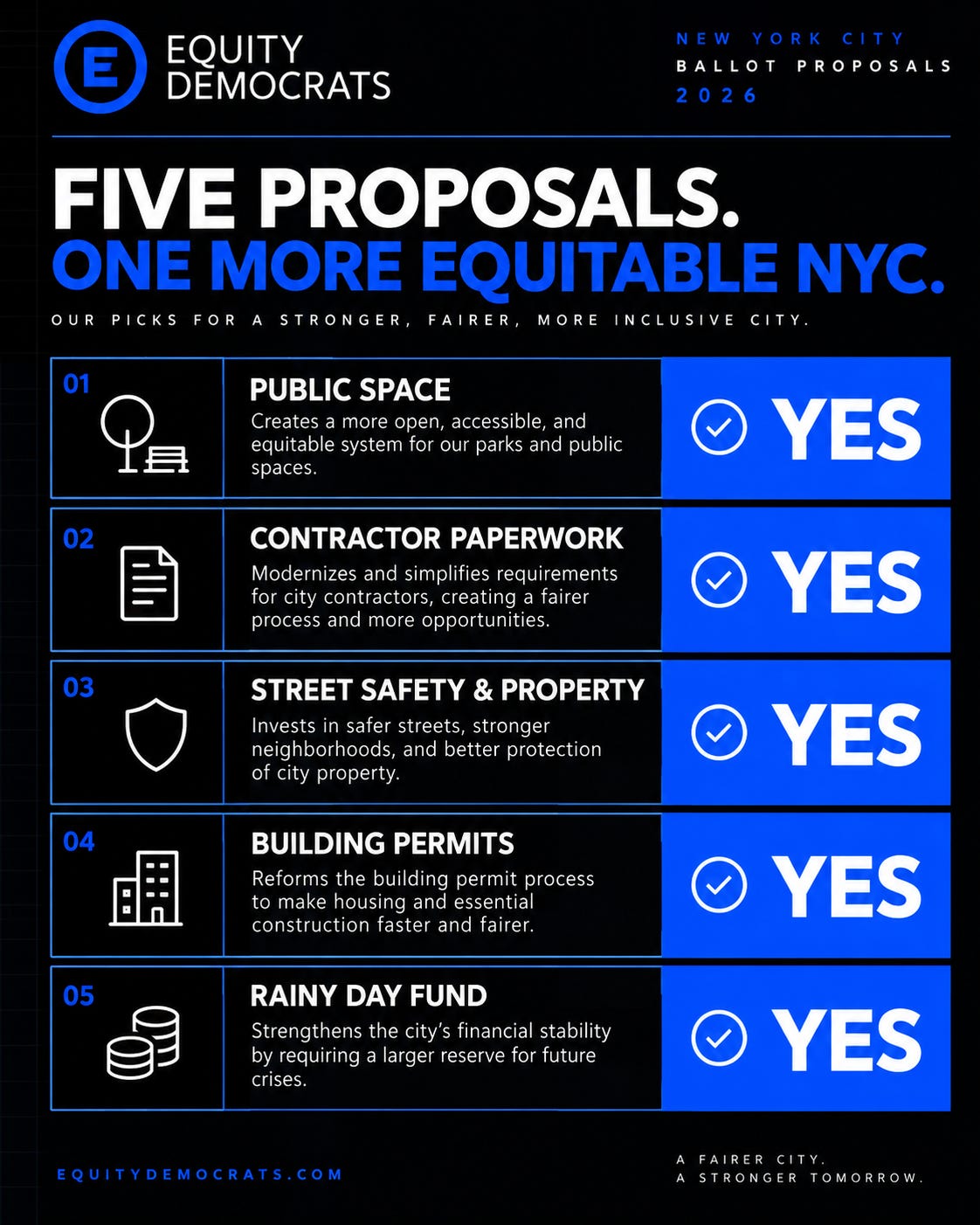
Today is the first day of early voting in NYC! There are five ballot proposals on the back of your ballot. My friends at Equity Democrats & I recommends a YES on all five for a more equitable NYC that can change faster.
A restaurant owner wants to put tables outside. A nonprofit wants to feed families. A neighborhood needs a safer intersection. A developer wants to build housing. Each encounters the same invisible obstacle: a government that often takes longer to authorize value than its people take to create it.
New York does not lack ambition, talent, capital, or labor. We lack the institutional speed to convert those resources into shared prosperity. We have built a city where delay is treated as accountability, even when delay itself produces inequality.
This November, five proposed amendments to New York City’s Charter ask whether our government can operate differently. They concern public space, contracting, street safety and city property, construction permitting, and financial reserves. Their common question is whether the machinery of government can become more responsive to the people it serves.
Consider the economics of waiting. A small business navigating months of permitting loses revenue before opening its doors. A community nonprofit waiting for a contract still has workers to pay. A dangerous intersection awaiting approval continues exposing pedestrians to preventable harm. Delays are not distributed equally. Wealthy institutions can purchase patience. Working people cannot.
The city’s Commission on Government Efficiency estimates that its proposed changes could reduce outdoor dining application times by 75%, accelerate street safety projects by at least a third, and consolidate construction approvals from 18 offices into a centralized system. These are projections, not guaranteed outcomes, but they reveal how much productive capacity may be trapped inside administrative procedures.
Citizens Union has supported all five amendments while warning that efficiency must preserve meaningful oversight. That distinction matters. Community advocates have raised legitimate concerns about reducing public hearings and combining unrelated changes into a single ballot question. Faster government cannot become government that simply stops listening.
But participation should produce influence, not indefinite paralysis. Accountability should measure outcomes as well as procedures. The real democratic question is not how many signatures a project requires, but whether residents can shape decisions and receive the benefits those decisions promise.
This is the central argument of Inclusionism: people create value through their interactions, and institutions must recognize that value by expanding their agency. A government that cannot translate collective effort into material improvements fails that obligation.
Even the proposed rainy-day reserve target belongs in this conversation. Financial resilience is not merely accounting. It is the capacity to protect public services and workers when the economy contracts. A target alone will not guarantee savings, but making the city’s reserve methodology public creates another standard against which government can be judged.
New York’s challenge is to become faster without becoming less democratic, more productive without becoming less equitable, and more financially disciplined without abandoning those who depend on public investment.
The city should be measured not by how difficult it is to change, but by how much better life becomes when it does.