

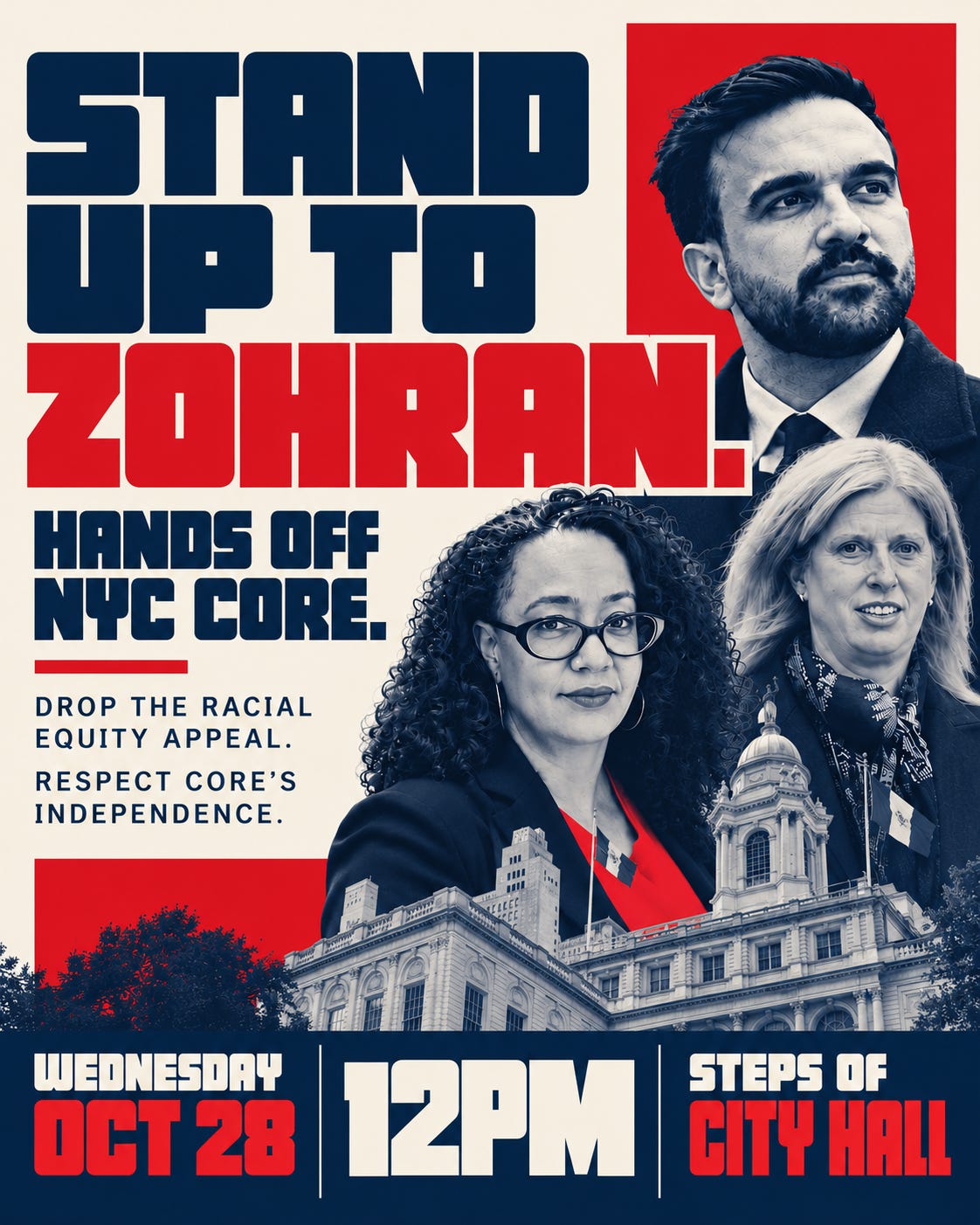
New Yorkers voted for racial equity in 2022. Four years later, we’re still fighting to make the city follow its own law.
For many Black New Yorkers, the Commission on Racial Equity (CORE) was one of the few lasting institutional victories to emerge during the Eric Adams administration. But CORE was not a gift from Adams. It was created by voters who amended the City Charter to require government to identify racial disparities, establish priorities, and measure progress.
And then the administration failed to meet the deadlines.
Under Chair and Executive Director Linda Tigani, CORE sued the city in 2025 to enforce its legal mandate. When Zohran Mamdani became mayor, his administration inherited that lawsuit and continued defending the city’s position. In August 2026, a judge ruled that the city had failed to comply with the Charter’s required timeline.
Mamdani’s administration published the city’s first final racial equity plan in September. That is progress. But the administration also appealed the ruling.
What Has New York City Actually Delivered?
CORE was established to do more than publish reports. It is supposed to provide independent oversight of the city’s racial equity commitments, identify community priorities, and evaluate whether government is making measurable progress.
In 2024, the City Council expanded CORE’s responsibilities to include a reparations study and a citywide Truth, Healing, and Reconciliation process.
These responsibilities require research, community engagement, public accountability, and sustained funding.
The record since CORE’s inception is mixed.
NYC CORE Accountability Report Card, 2022–2026
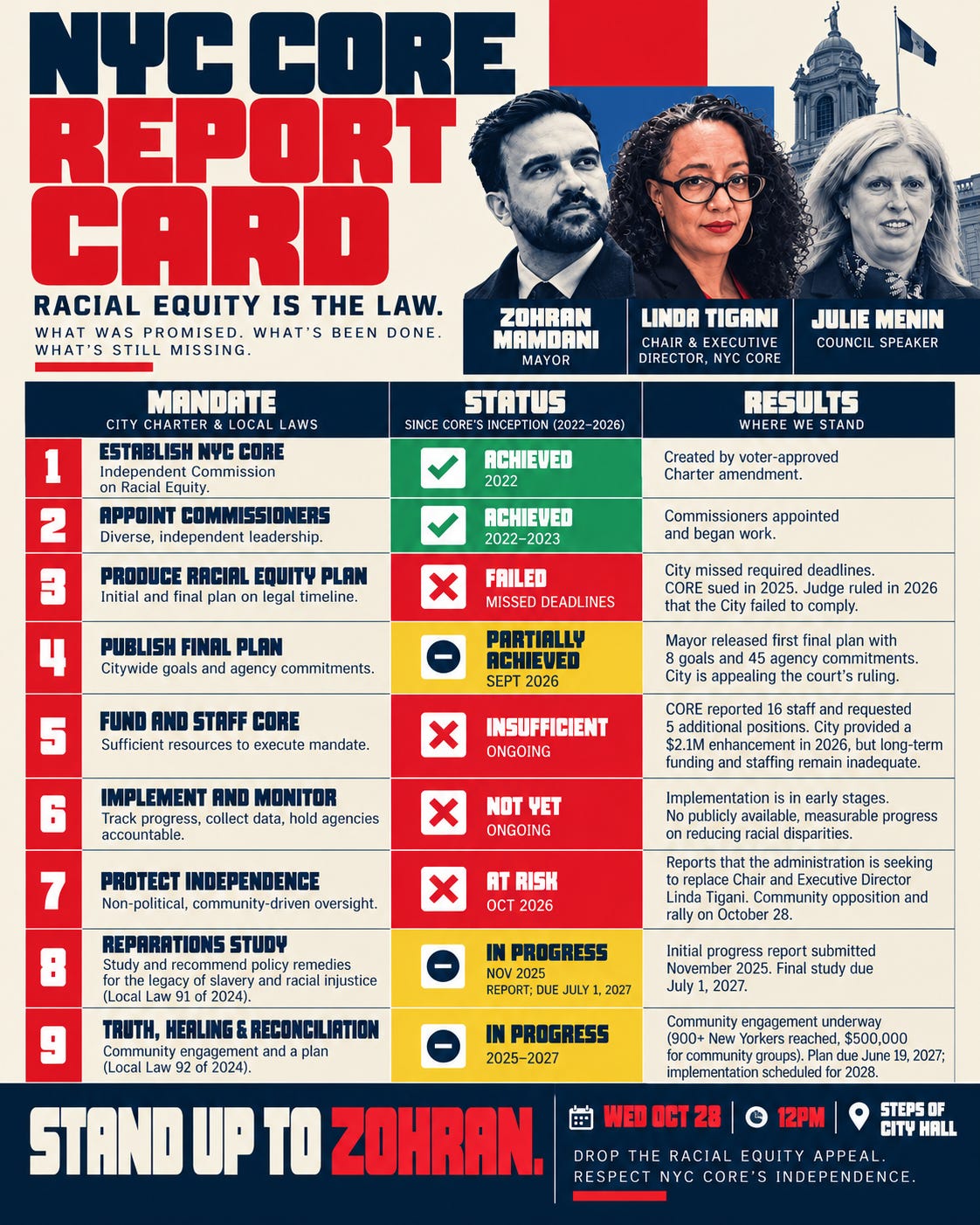
These are nine areas of public accountability, not nine separate statutory mandates. Work with future legal deadlines should not be characterized as overdue.
The distinction matters. CORE cannot implement racial equity on behalf of every city agency. It can investigate, monitor, report, and hold government accountable. City Hall must provide the resources and demonstrate the results.
Why Community Members Are Standing Up Now
The immediate concern is the future of Linda Tigani, CORE’s chair and executive director.
Community organizer Tanesha Grant says she has direct knowledge of an effort by Mayor Mamdani to replace Tigani, potentially before the end of October, with Council Speaker Julie Menin’s agreement. That account has not been independently confirmed. No removal decision or successor has been publicly announced.
The question being raised by community members is specific: Will the city replace the leader under whose tenure CORE sued it to enforce the racial equity mandate?
There may be legitimate reasons for changes in public leadership. But the public deserves an explanation of any proposed change, particularly when the institution’s independence is central to its legal purpose.
Tigani’s leadership has been associated with CORE’s willingness to challenge City Hall. Replacing her would not automatically eliminate CORE’s independence, but it would make the safeguards around that independence especially important.
The mayor and Council speaker should clarify whether a leadership change is being considered, explain the process and legal basis for any such change, and demonstrate how CORE’s oversight authority would be preserved.
The Burden Cannot Keep Falling on Black New Yorkers
Here is the institutional problem: Black New Yorkers fought to create a commission that would hold government accountable. That commission had to sue the city to enforce the law. If its independence is weakened, communities could find themselves fighting yet another battle to make the watchdog do its job.
At what point does government take responsibility for the work voters already ordered it to do?
We cannot keep asking grassroots organizers to collect the evidence, attend the hearings, write the petitions, finance the lawsuits, and repeat the process whenever a new administration takes office.
CORE’s independence, its capacity to complete the reparations study and reconciliation process, and the city’s obligation to deliver measurable racial equity outcomes are all part of the same institutional question.
A press conference and rally is scheduled for Wednesday, October 28, at noon on the steps of City Hall, focused on CORE’s independence and the city’s racial equity appeal.
Sign the petition to retain Linda Tigani as CORE chair and executive director
The question is no longer whether New York City recognizes racial inequity. The voters answered that in 2022.
The question is how many more times Black New Yorkers must fight to make their government obey the law.