

Keeper of the Flame, Keeper of the Future
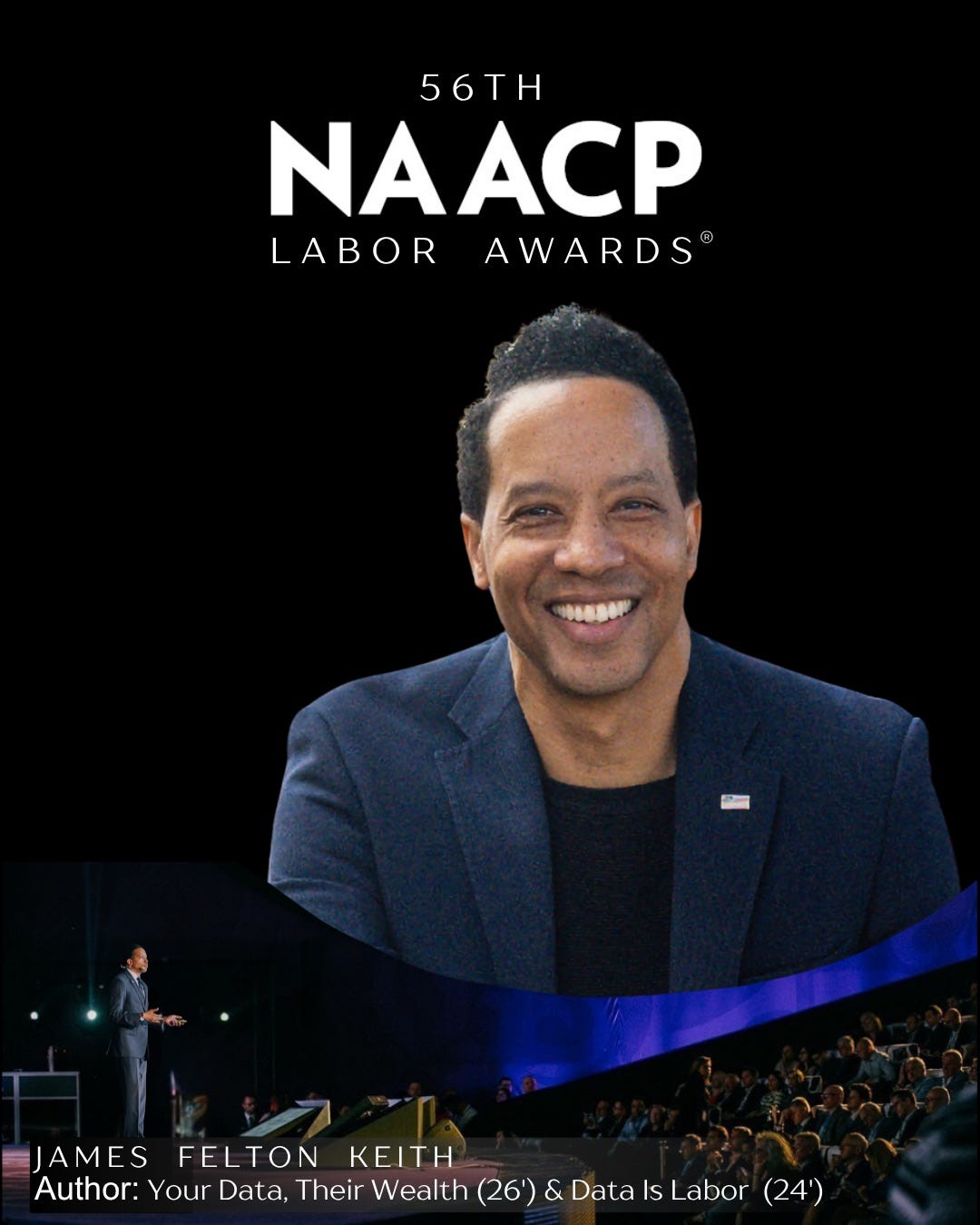
I am honored to accept the 2026 Benjamin L. Hooks Keeper of the Flame Award from the NAACP National Labor Committee.
I receive this recognition with gratitude, humility, and responsibility.
Benjamin L. Hooks stood in a tradition that understood a truth too many institutions still resist: civil rights and labor rights cannot be separated. If a person has dignity, then that dignity must follow them into the workplace. If a person has standing, then that standing must extend into the systems that profit from their labor. If a person has rights, then those rights must matter not only in law and principle, but in economics.
That is the spirit in which I accept this award.
I also accept it at a moment when the definition of labor is being contested in real time.
For generations, workers were told that labor meant the hours they could prove, the motions they could document, the products they could hold, the output an employer could count. But today, in the AI economy, value is increasingly generated in ways that do not fit those old categories. Our actions, choices, preferences, corrections, movements, relationships, histories, and digital traces are constantly being absorbed into productive systems. These systems call us users while using us. They call our contribution data while pricing it as if it appeared by magic.
My book, Your Data, Their Wealth: The Price of Human Input to the AI Economy, and our recent paper, “The Two Faces of the Invisible Economy: Pricing Personal Data Inputs and Measuring Machine Labor Outputs in the AI Economy,” make a simple argument with far-reaching consequences:
Human data input is not a byproduct. It is a factor of production.
And if that is true, then labor must evolve its bargaining strategy.
The Next Frontier of Collective Bargaining
For too long, collective bargaining has been limited by the categories the industrial economy handed to us. Wages. Hours. Benefits. Scheduling. Safety. Classification. Surveillance. Those remain essential. But they are no longer enough.
Because in the AI economy, workers are not only selling time.
They are producing intelligence.
They are training models with their corrections.
They are improving systems with their behavior.
They are reducing uncertainty with their participation.
They are generating value with every workflow, communication pattern, preference signal, and digital interaction that can be captured, aggregated, and monetized.
This means there is now a new terrain of bargaining:
the right to collectively bargain around personal data input as a new asset class.
That is the shift.
Not bargaining only about what a worker is paid after value is created.
But bargaining about the very inputs from which that value is created in the first place.
What It Means to Bargain Around Personal Data
To collective bargain using personal data is not to individualize labor. It is the opposite. It is to recognize that personal data, when captured at scale, becomes a collective economic resource. Workers do not merely produce widgets, code, services, or care. They also produce patterns, training signals, performance traces, and institutional intelligence.
Those inputs already affect productivity, profitability, risk scoring, workforce management, and investor valuation.
The problem is not that this value does not exist.
The problem is that it is unrecognized where it matters most.
A new bargaining strategy must begin there.
It must ask:
What human inputs are being captured from workers in the course of productive activity?
How are those inputs being measured, classified, stored, and monetized?
Which systems are learning from workers without compensating them?
How should workers collectively govern the reuse of their behavioral, operational, and relational data?
How should unions negotiate over the value generated by data that emerges from work itself?
These are not theoretical questions. They are labor questions.
A New Bargaining Agenda
I believe labor’s next chapter requires at least five new bargaining demands.
1. Recognition
Unions and worker organizations must force employers to recognize that human data input is part of the value workers create. If it contributes to productivity, optimization, automation, or valuation, then it belongs in the bargaining conversation.
2. Measurement
What is invisible cannot be negotiated. Workers need a credible measurement layer that identifies the forms of human input being extracted from digital systems, workflows, and organizational life. Bargaining begins with legibility.
3. Governance
Workers must have collective say over how their data is used, shared, modeled, licensed, or repurposed. Consent cannot be reduced to HR paperwork or hidden platform terms. Governance must be collective, not merely individual.
4. Compensation
If worker-generated data improves systems and creates economic gain, then labor must explore how compensation should attach to that gain. That could include new mechanisms tied to productivity sharing, licensing, dividend structures, or collectively negotiated value participation.
5. Ownership and Power
The end goal is not only payment. It is power. Bargaining around personal data means creating durable worker leverage over the systems that increasingly shape work itself.
Why This Matters for Civil Rights
This is not just a labor issue. It is a civil rights issue.
Because invisibility is never neutral.
The communities whose labor has most often been undercounted in history are the same communities most likely to have their digital contribution extracted without recognition now. Black workers, women, immigrants, contingent workers, disabled workers, queer workers, and low-wage workers know what it means to be essential without being fully valued. The AI economy is at risk of automating that old injustice at a much larger scale.
That is why I believe Benjamin L. Hooks belongs in this conversation.
Hooks understood that rights without power are fragile. He understood that formal inclusion without economic standing is incomplete. He understood that labor is one of the places where democracy either becomes real or remains rhetorical.
Today, the workplace has expanded. It is no longer only the factory, office, school, warehouse, hospital, hotel, or shop floor. It is also the data exhaust of those spaces. The predictive layer above them. The algorithmic shadow attached to every act of work.
If civil rights and labor rights cannot be separated, then neither can labor rights and data rights.
A Preamble to What Comes Next
At the NAACP Convention, I intend to say more about how labor can organize around this reality.
Not as an abstraction.
Not as a branding exercise.
Not as “AI ethics” without economics.
But as a practical strategy.
A strategy to help unions, worker centers, civil rights organizations, and communities understand that workers are already contributing more than the old categories can measure.
A strategy to bargain not only over labor conditions, but over labor’s hidden informational output.
A strategy to insist that if workers are helping produce intelligence, then workers must have rights in the economy intelligence creates.
I am honored by this award because it recognizes work at the intersection of civil rights, labor rights, and economic justice. But I hope to earn it by helping open the next chapter of labor strategy.
The future of collective bargaining will not be won by ignoring the digital evidence of human contribution.
It will be won by naming it, measuring it, organizing it, and bargaining with it.
That is the work before us.
And that is the flame I intend to keep.