

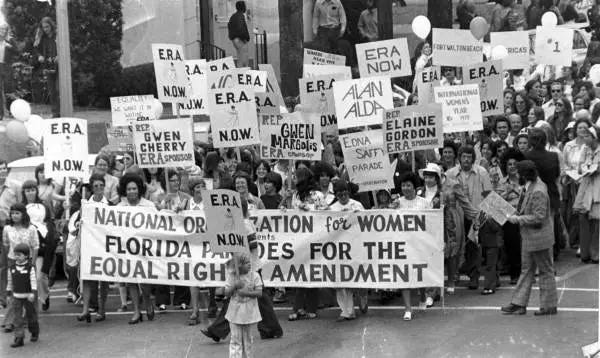
On this day 1 year ago, the US President honored the ratification of what should be the United States’s 28th Amendment, as 38 states ratified the Equal Rights Amendment (ERA) by 2020 — meeting the original constitutional threshold. It took 5 years for Leftists like President Biden to use this Amendment to benefit us, but he was cautious his entire term to avoid upsetting the Right which has always been in opposition to the integration and progress of all American citizens. This was a huge failure, and will one of our core tool in clawing back the rights that we are owed from a state level. I should say at less than 38 state levels, but implementing an ERA at the state level is much more difficult in some oft he 38 states, like Texas, than endorsing it nationally. The ERA was a big failure in exerting power by Biden’s Democrats.
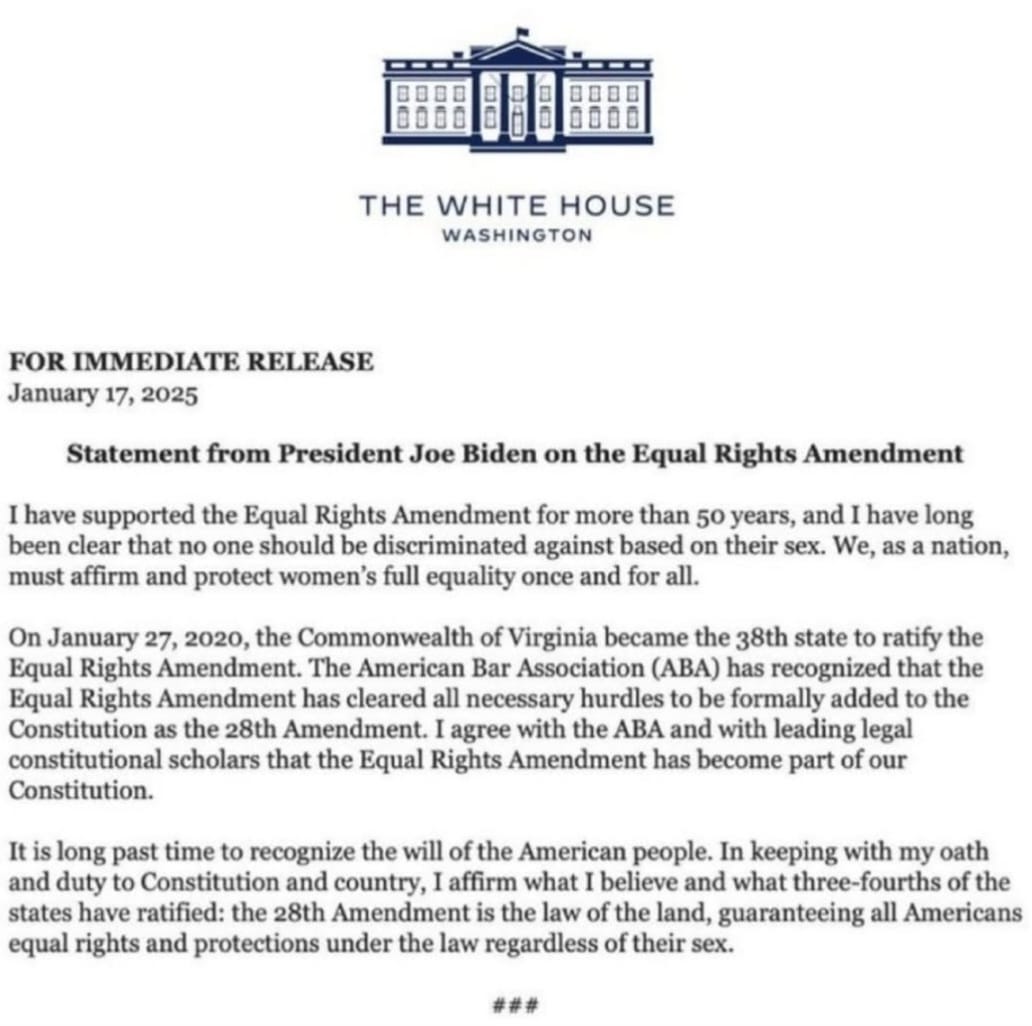
Here they are, in order of ratification:
Hawaii
New Hampshire
Delaware
Iowa
Idaho
Kansas
Nebraska
Texas
Tennessee
Alaska
Rhode Island
New Jersey
Colorado
West Virginia
Wisconsin
New York
Michigan
Maryland
Massachusetts
Kentucky
Pennsylvania
California
Wyoming
South Dakota
Oregon
Minnesota
New Mexico
Vermont
Connecticut
Washington
Maine
Montana
Ohio
North Dakota
Indiana
Nevada (2017)
Illinois (2018)
Virginia (2020)
Herstory
35 states ratified by 1977, before Congress’s original deadline.
Nevada, Illinois, and Virginia pushed it to 38 decades later.
Five states claim rescission (Idaho, Kentucky, Nebraska, Tennessee, South Dakota), which fuels the legal fight.
Whether the ERA is legally effective today hinges on deadline and rescission disputes, not on the raw count.
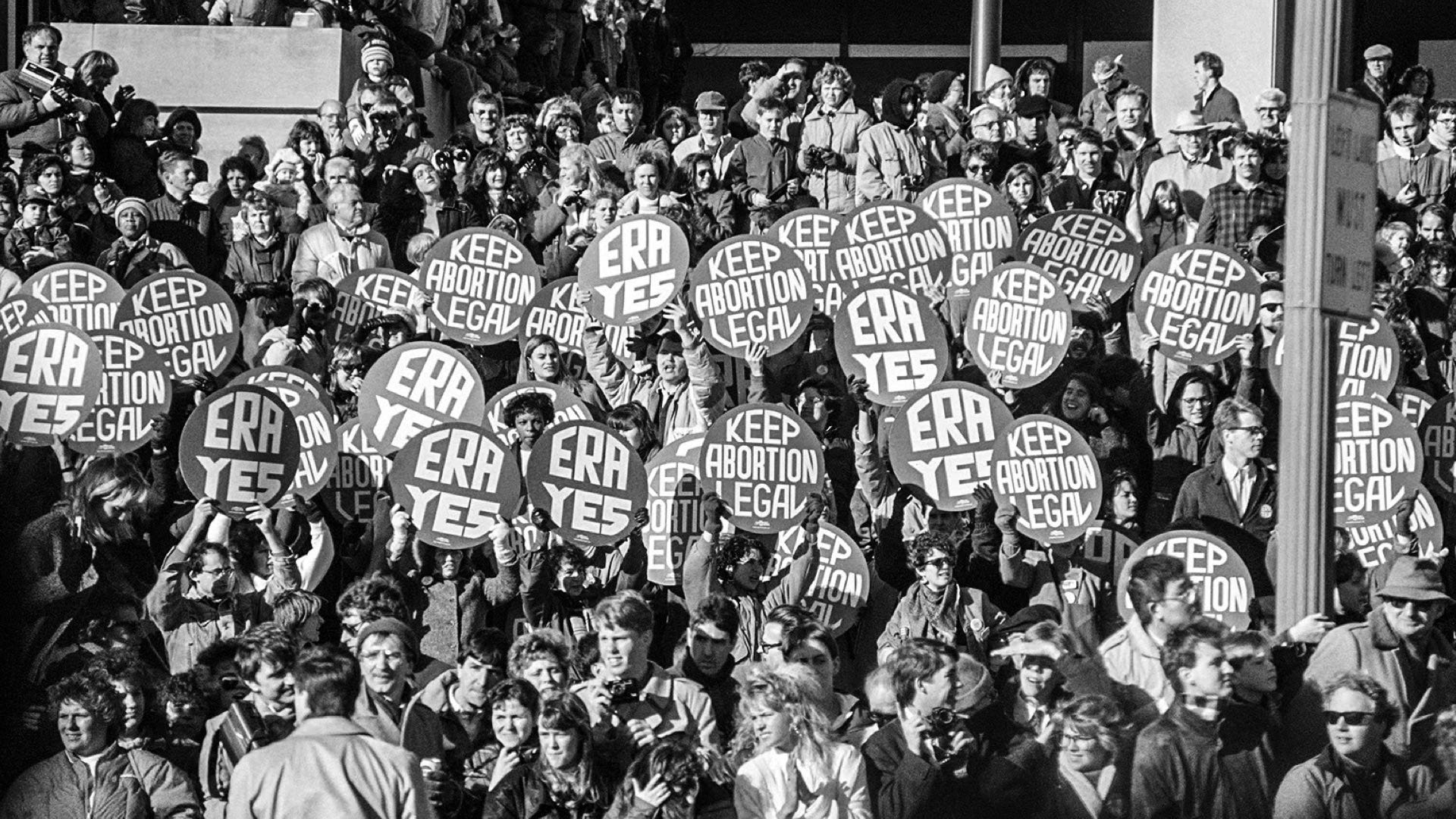
The Equal Rights Amendment should have been forced to resolution years ago—not because it was fashionable, but because constitutional clarity matters. By the time Nevada and Illinois ratified in 2017 and 2018, the country had already crossed the threshold where delay became institutional cowardice. Every year the ERA was left in limbo weakened respect for Article V itself, teaching states that their ratifications could be treated as provisional and disposable. A serious constitutional order does not leave fundamental questions of equality suspended for decades because they are politically inconvenient. Earlier executive and congressional pressure would not have “short-circuited” the process; it would have honored it by compelling the courts or Congress to do their jobs and settle the question cleanly.
The deeper failure was not legal but moral and procedural. The federal government routinely moves faster to clarify tax law, trade authority, or emergency powers than it did to resolve whether sex equality belongs in the Constitution. That inversion of priorities is telling. By refusing to push the ERA to conclusion earlier—either by waiving the deadline, recognizing ratifications, or forcing judicial review—national leadership allowed procedural ambiguity to become a substitute for democratic judgment. In a system built on amendments, kicking the can is not neutrality; it is dereliction. The ERA deserved an answer decades ago, win or lose, because a republic that cannot decide what its Constitution says is one quietly abandoning constitutional discipline itself.
Well before the federal Equal Rights Amendment stalled, many states did something more conservative than critics admit: they locked in clear rules and reduced discretion. States like New York, Pennsylvania, California, Maryland, Massachusetts, and Washington embedded sex-equality guarantees directly into their constitutions not to chase social trends, but to stabilize expectations across public and private life. New York’s constitution, strengthened again in 2024, does exactly what good constitutional design is supposed to do—it creates predictability. For corporate actors, that predictability matters. When equality standards are constitutional, companies stop guessing where the legal floor is and start building compliance, talent strategy, and risk management around a settled rule rather than shifting political winds.
The real power of state ERAs lies in how they discipline markets without micromanaging them. Courts in ERA states apply heightened scrutiny to sex-based distinctions, which quietly incentivizes corporations to standardize pay, promotion, benefits, and workplace policy before litigation ever arises. That is deliberate equity and inclusion—not as ideology, but as risk control. Firms operating in New York already understand this logic: it is cheaper and more stable to design systems that treat workers consistently than to defend exceptions one lawsuit at a time. From a conservative standpoint, this is not social engineering; it is rule-of-law capitalism.
For states considering whether to follow New York, the hurdles are mostly political inertia and fear of overreach, not legal uncertainty. Amendment procedures are often slow by design, but that slowness should not be confused with prudence. A state ERA does not mandate quotas, speech codes, or corporate governance models. It sets a constitutional baseline and lets markets adapt. In practice, companies respond by formalizing HR processes, documenting decisions, and investing in compliance infrastructure—classic conservative virtues that reduce arbitrary decision-making and protect enterprise value.
The litigation anxiety often raised against state ERAs also misses the point. Experience shows that ERAs do not unleash judicial chaos; they narrow the field of dispute. Clear equality standards reduce frivolous claims and channel real conflicts into predictable legal tests. For corporations, this clarity is a feature, not a bug. It rewards firms that invest early in fair systems and penalizes those that rely on informal hierarchies or legacy practices that no longer hold up. That dynamic encourages inclusion without government planning and without permanent regulatory expansion.
The broader lesson, nationally and internationally, is that the ERA model is a quiet hack to conservatism, not an assault on it. Constitutional equality shifts equity work out of cultural battles and into institutional design, where conservatives have always been strongest. It replaces moral argument with structural incentive, activism with architecture. In that sense, the ERA is not about pushing society left or right—it is about anchoring fairness in durable rules so that businesses, governments, and workers can compete on clear terms. That is how inclusion becomes sustainable, and that is why states like New York point the way forward.
Onwards to #Inclusionism